Films centered on child protagonists are one of the defining traditions of both pre- and post-revolutionary Iranian cinema. They are often labeled “children’s films,” but that description can be misleading. Only some of these films were genuinely made for young audiences; others were intended primarily for adults. By telling their stories through a child’s perspective, these films explore complex social, philosophical, and political questions while showcasing the distinctive artistic vision of their directors.
The remarkable place of child-centered films in Iranian cinema is closely tied to the Institute for the Intellectual Development of Children and Young Adults, better known as KANOON. The institute was founded in 1965 during the reign of Shah Mohammad Reza Pahlavi. Under the patronage of Empress Farah Pahlavi, it operated as a state-funded cultural organization devoted to education and the creative development of children. Alongside an extensive network of libraries, KANOON operated a publishing house, a film studio, and an archive of children’s films from around the world.
Unlike commercial studios, KANOON was not driven by box office returns or immediate financial success. This gave filmmakers the freedom to devote exceptional care to their screenplays and engage with challenging social themes. Many of the directors who worked there were key figures of the Iranian New Wave, using the institute as a place to refine their distinctive cinematic voices. Director Kyumars Pourahmad later recalled that he had to rewrite his first screenplay thirteen times before it was approved by KANOON’s head of film production, Ebrahim Forouzesh.1 As a result, the institute’s films became known for their artistic ambition, understated realism, and serious tone—qualities that some contemporary critics even described as darkly ironic or pessimistic.2
KANOON pursued a similar vision in publishing. Alongside beautifully illustrated children’s books, it produced works whose symbolic storytelling invited readers to see them as subtle critiques of the Shah’s authoritarian rule. The most celebrated example is The Little Black Fish (Mahi-ye Siyah-e Kuchulu, 1967) by Samad Behrangi, illustrated by Farshid Mesghali. For an entire generation, its story of a small fish searching for freedom and knowledge stood as an allegory of resistance against the regime.3
KANOON survived the 1979 Islamic Revolution and continued to expand its library network, support children’s filmmaking, and preserve film heritage.4 It was within the institute that some of the most important works by Abbas Kiarostami, Amir Naderi, Bahram Beyzaie, Majid Majidi, and Mohammad Ali Talebi were created. In their films, child protagonists embody humanistic values such as honesty, compassion, perseverance, and responsibility. At the same time, they serve as observers of a society marked by revolution, poverty, and the Iran-Iraq War.
These films were not openly oppositional, yet their blend of contemplative storytelling and profound humanism offered a quiet alternative to the state’s revolutionary cultural agenda. Their emphasis on ethics and spirituality also allowed them to exist within the constraints of strict government censorship. After Mahmoud Ahmadinejad took office as president in 2005 and the influence of the Islamic Revolutionary Guard Corps continued to grow, the cultural climate changed significantly. Although the humanist tradition endured, its tone became increasingly urgent, engaging more directly with the political and social realities of contemporary Iran.5
The following curated selection presents ten essential Iranian films featuring child protagonists, spanning the pre-revolutionary era to the present day. Together, they trace the evolution of Iranian society while offering a compelling journey through the history of Iranian cinema.
The Traveler (1974), dir. Abbas Kiarostami

Abbas Kiarostami’s early feature The Traveler (Mossafer) offers an unsentimental portrait of childhood in pre-revolutionary Iran. Qassem, a thirteen-year-old boy from a poor provincial area, is obsessed with soccer. His greatest dream is to travel to Tehran and see his favorite team play for the first time. Kiarostami builds the film around a restrained realist style, only to disrupt it at a pivotal moment with a dream sequence that closely resembles reality—a hallmark of modernist cinema in the 1970s.
For Qassem, modern urban life exists only as a distant spectacle. It is a world he can observe but never truly belong to. His inability to connect with the children of Tehran underscores the film’s social critique. The Shah’s modernization program widened the gap between rich and poor, as well as between the city and the countryside. Yet Kiarostami avoids sentimentality. Qassem is far from an innocent child. To pay for his journey and the match ticket, he lies, cheats, and manipulates those around him. This moral ambiguity sets The Traveler apart from many Iranian films of the 1990s, in which child protagonists often embody ethical integrity.
The Runner (1984), dir. Amir Naderi

Amir Naderi’s The Runner (Davandeh) is one of the defining works of 1980s Iranian cinema and among the first Iranian films after the Islamic Revolution to gain widespread international recognition. Through the story of Amiro, an orphaned boy struggling to survive on society’s margins, Naderi crafts a timeless meditation on dignity, knowledge, and the pursuit of a better future. The film draws heavily on the director’s own childhood. After losing his parents, Naderi grew up in the southern port city of Abadan, a place that would become central to his filmmaking.
Narratively and visually, The Runner is a model of cinematic minimalism. Cinematographer Firouz Malekzadeh frequently observes the characters from a distance with long lenses, giving the film an almost documentary quality. The coastal landscape unfolds in soft pastel hues, where pale yellow sand merges with the blue of the sea and sky.
Beneath this visual simplicity lies a rich historical subtext. Amiro shines shoes for Western visitors, listens to foreign music, and wanders among ships arriving from overseas. These images evoke not Iran in 1984, when the film was made, but Naderi’s memories of pre-revolutionary Abadan—a cosmopolitan oil city shaped by international exchange as well as social inequality. At the same time, the film bears the scars of the Iran-Iraq War. The metaphorical flames of the oil refineries and the scarred landscape subtly allude to the war. Existing somewhere between memory and the present, The Runner demonstrates how films about children can also serve as reflections on history, society, and human resilience.
Where Is the Friend’s House? (1987), dir. Abbas Kiarostami

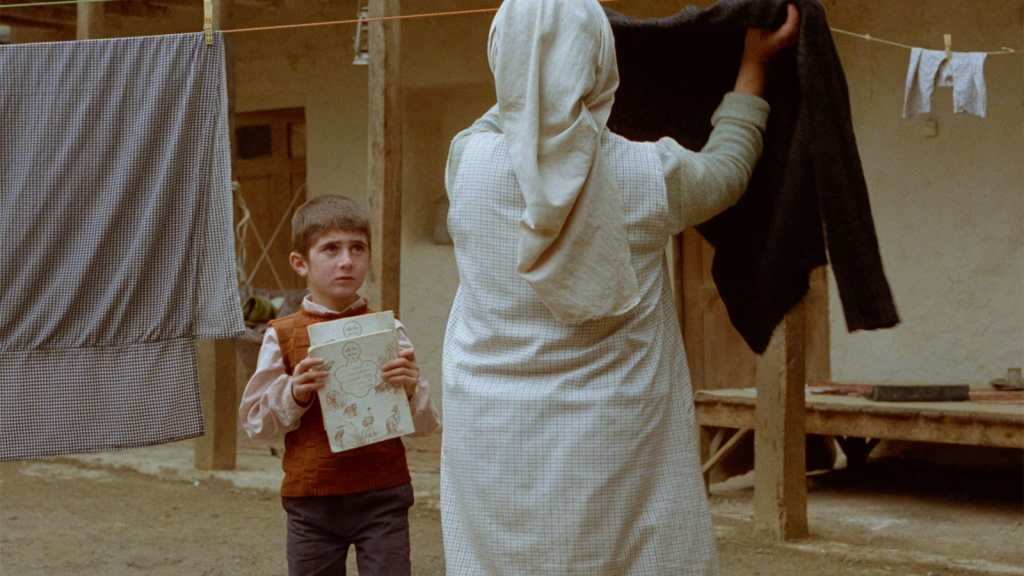
Where Is the Friend’s House? (Khaneh-ye Doust Kojast?) stands as one of the masterpieces of Iranian poetic realism. The story appears deceptively simple. Ahmed, an elementary school student, accidentally takes home his classmate Mohammad Reza’s notebook. Fearing his friend will be punished for not completing his homework, he sets out to find his house in a neighboring village. This modest childhood quest evolves into a reflection on responsibility, conscience, and the widening gap between children and adults.
Through Ahmed’s journey, Kiarostami captures the disciplinary nature of post-revolutionary society, where adult authority often silences the voices of children. His mother and other adults repeatedly ignore or dismiss his concerns. The neighboring village feels enclosed and unfamiliar, creating an atmosphere of alienation where genuine human connection seems almost impossible.
Yet the film never loses its sense of hope. Kiarostami combines realism with a carefully crafted visual lyricism. Repeated images of village doorways, landscapes, and the flower pressed into the notebook transform the story into a cinematic poem. Ahmed is also the prototype for the altruistic child protagonists who would define much of Iranian cinema in the 1990s. Unlike the more overtly spiritual films of Majid Majidi, however, Kiarostami remains more grounded in everyday reality and secular humanism.
Bashu, the Little Stranger (1989), dir. Bahram Beyzaie

Bahram Beyzaie’s Bashu, the Little Stranger (Bashu, Gharibe-ye Koochak) stands as a powerful counterpoint to the so-called “Sacred Defense” cinema that portrayed the Iran-Iraq War through the lens of state ideology. After losing his family in the conflict, young Bashu flees the devastated south and eventually arrives in the lush subtropical north of Iran. There, despite the suspicion of the local community, a rural woman named Na’i takes him into her home. Their unlikely bond grows into a deeply moving story about belonging, family, and the search for a new home.
Beyzaie also uses their encounter to explore Iran’s remarkable internal diversity. Bashu and Na’i come from different ethnic, linguistic, and cultural backgrounds. Difference initially leads to fear and prejudice, but gradually gives way to empathy and mutual understanding.
A renowned scholar of traditional Iranian theater, Beyzaie departs from the narrative minimalism associated with Kiarostami and Naderi. His magical realist approach weaves folklore, ritual, and humanity’s relationship with nature into the fabric of everyday life. Bashu, the Little Stranger embraces a richly syncretic vision of Iranian culture, continuing an approach Beyzaie had already developed in The Stranger and the Fog (Gharibeh va Meh, 1974). Bashu is more than a realistic representation of wartime trauma. He also emerges as an almost mythical figure whose presence has the power to heal those around him. By bringing together an intimate human story with Iran’s cultural and anthropological diversity, Beyzaie created one of the landmark achievements of Iranian cinema.
Bag of Rice (1997), dir. Mohammad Ali Talebi

In Bag of Rice (Kiseh-ye Berenj), Mohammad Ali Talebi finds transcendence in the simplest acts of kindness. The film was made as Iranian society was recovering from the devastating consequences of the eight-year Iran-Iraq War. Years of conflict had reshaped everyday life and left the country’s economy in ruins. At the same time, the experience of war strengthened a sense of solidarity and shared responsibility—values that became central to many Iranian films about children, including Bag of Rice.
The story follows a little girl named Jeyran, who helps her elderly neighbor carry home a heavy sack of rice. An ordinary childhood adventure evolves into a deeply humanistic reflection on compassion. Talebi grounds this simple narrative within the broader cultural memory of both pre-Islamic and Islamic Iran.
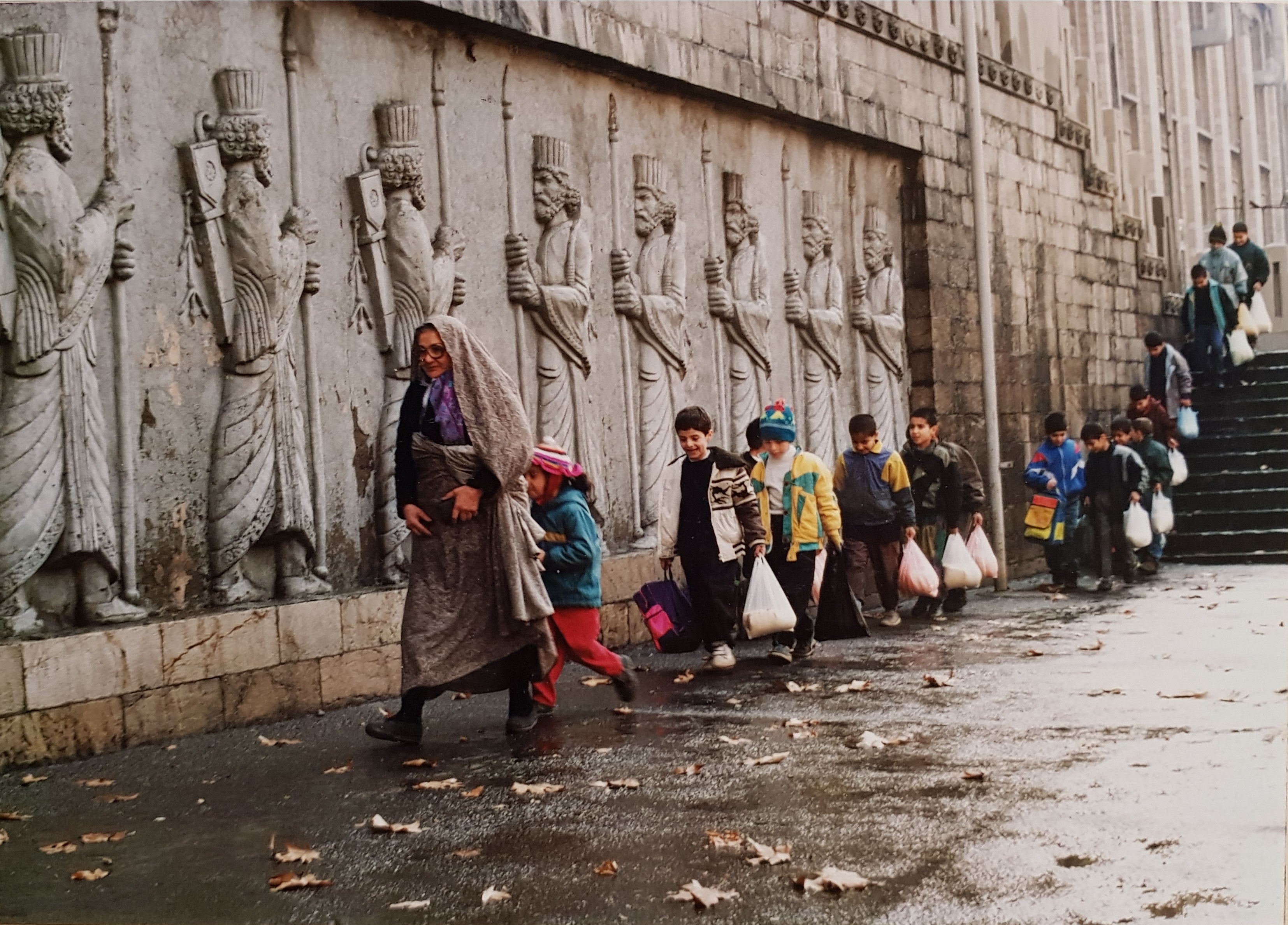
In one of the film’s most memorable scenes, Jeyran, the elderly woman, and a group of schoolchildren carrying bags of rice pass a relief inspired by Persepolis. The image recalls the Achaemenid Empire at the height of its power. By the end of the film, however, the symbolism has shifted toward the Islamic tradition. During a Shi’a religious ritual, rice transcends its everyday purpose, taking on the symbolic meaning of community, generosity, and blessing. Together, these pre-Islamic and Islamic references place the film’s intimate story within the larger continuum of Iranian cultural identity.
Children of Heaven (1997), dir. Majid Majidi

Majid Majidi’s Children of Heaven (Bacheha-ye Aseman) remains one of the most beloved films of 1990s Iranian cinema. Like many Iranian films centered on children, it begins with the everyday realities of poverty. Young Ali loses his sister Zahra’s shoes after picking them up from a shoe repair shop. This simple incident sets in motion a moving story about sibling devotion, family sacrifice, and the quiet resilience of ordinary people. In this sense, the film continues the postwar tradition of portraying collective responsibility and mutual care.
Majidi enriches this social realism with a spiritual dimension. Ali’s suffering can be read as an echo of the Shi’a tradition of martyrdom, while his inner transformation reflects the influence of Sufi mysticism, a central theme in classical Persian poetry. His determination is driven not by fear of punishment but by compassion for his family and an acute awareness of their financial hardship.
The film is even more revealing when viewed alongside Kiarostami’s pre-revolutionary work. Unlike the self-interested protagonist of The Traveler, who lacks a sense of family or communal responsibility, Ali embodies the ideal child. The climactic race becomes a spiritual trial in which suffering is redeemed through love, and self-sacrifice opens the door to transcendence.
The Mirror (1997), dir. Jafar Panahi

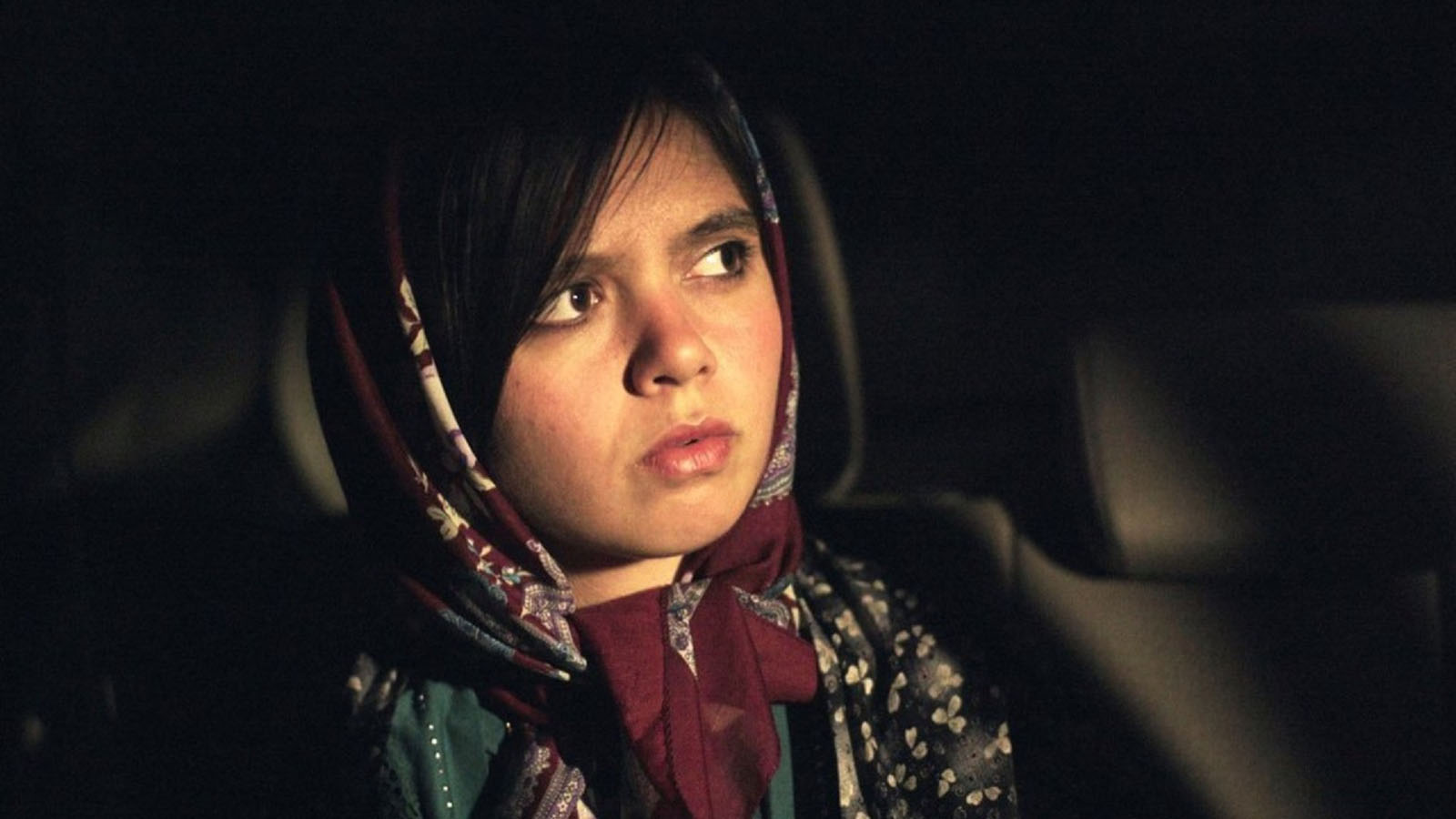
Jafar Panahi’s The Mirror (Ayneh) marks a turning point in the evolution of Iranian cinema featuring child protagonists. Is it merely the story of a little girl trying to find her way home? Far from it. The film can also be read as a carefully constructed political allegory and a subtle satire.
Mina’s journey through Tehran is anything but arbitrary. Panahi guides her through locations whose names carry the living memory of the Iranian Revolution. Streets such as Pirouzi (“Victory”) and Meydan-e Shohada (“Martyrs’ Square”) are embedded with political and historical meaning. Rather than explaining their significance, Panahi allows the city itself to speak. Through understated irony, these symbolic spaces offer a quiet political commentary. Their names commemorate revolution, victory, and martyrdom, yet the film refuses to celebrate the ideology they represent.
A socially critical perspective was already evident in Panahi’s debut feature, The White Balloon (Badkonak-e Sefid, 1995), whose ending reminds viewers that the postwar ideal of national unity never embraced everyone equally—the Afghan boy is left alone. The Mirror, however, goes further. It challenges dominant ideological narratives not only through its story but also through its formal experimentation, provocative parallels, and self-reflexive style. In doing so, it foreshadows the more openly dissident cinema Panahi would later create.
The Apple (1998), dir. Samira Makhmalbaf

Samira Makhmalbaf’s feature debut, The Apple (Sib), was inspired by a true story she first encountered in a television news report. It follows twelve-year-old twin sisters Massoumeh and Zahra, who have spent most of their lives confined to their family home by their father. When social workers finally intervene, the girls step into a world they have previously known only through the walls of their house. The film was made without a completed screenplay, shot chronologically, and features the real family playing themselves. The result is an extraordinary blend of documentary authenticity and fiction that resists easy moral judgment.
The threshold of the family home is the film’s central metaphor. It separates the protected private sphere from the public world that has been denied to the girls. This image draws on the traditional Iranian understanding of the home as an enclosed space meant to safeguard family life and privacy. Makhmalbaf reveals how a place designed for protection can also become a mechanism of isolation. When the sisters finally step outside, the moment signifies more than physical liberation. It marks the beginning of a gradual process of learning, communication, and discovering both freedom and responsibility.
Buddha Collapsed Out of Shame (2007), dir. Hana Makhmalbaf

Like her sister Samira, Hana Makhmalbaf made an extraordinary debut with Buddha Collapsed Out of Shame (Buda az sharm foru rikht). The story follows a little girl named Bakhtay, who lives with her family in Bamiyan, Afghanistan. Nearby rise the towering rocks where the monumental Buddha statues once stood until the Taliban destroyed them in 2001, believing they were forbidden idols. Determined to learn to read and write, Bakhtay goes to school on her own. Her journey toward education soon leads to a series of painful encounters with children whose games reproduce the violence of both religious extremism and American militarism.
Makhmalbaf cast local non-professional actors from Bamiyan and adopted a documentary-style approach, creating a film that moves fluidly between fiction, documentary, and allegory. Through a child’s perspective, she captures the collision between innocence and a world marked by violence with remarkable clarity. The title extends the film beyond the historical event itself. The Buddha did not “collapse” because of explosives, but out of shame over human suffering—especially the suffering of children.
Sun Children (2020), dir. Majid Majidi

Majid Majidi’s Sun Children (Khorshid) is a powerful examination of one of the most pressing humanitarian issues of our time: child labor. Its ethical commitment is reflected in its production. Every main child role is played by a real working child, giving the film remarkable authenticity. It also draws attention to a talented yet often overlooked group of young people. Twelve-year-old Ali and his three friends survive through petty theft until a local crime boss gives them an unusual assignment: find a hidden treasure buried beneath a school. To dig the tunnel without attracting suspicion, the boys enroll in the aptly named Sun School.
Compared with the hopeful spirit of Children of Heaven, Sun Children is considerably darker and more pessimistic. The shift reflects both the evolution of contemporary Iranian cinema and the country’s changing social climate. Growing public frustration and repeated waves of protest have encouraged filmmakers to confront reality more directly and critically.
Yet Majidi does not abandon the spiritual sensibility that has long distinguished his work. Once again, the physical world points toward something beyond itself. Space is the film’s defining metaphor as the story moves between the claustrophobic darkness of the underground tunnel and the sunlit openness of the city above. Here, the sun is more than a source of light. It becomes a symbol of hope—always visible, yet almost impossible to reach.
Iran Zamin Cinema is an independent, ad-free publication dedicated to Iranian cinema. Support the project on Buy Me a Coffee and help keep thoughtful essays and film analysis freely available.

- Hamid Naficy, A Social History of Iranian Cinema: Volume 2, The Industrializing Years, 1941–1978 (Durham and London: Duke University Press, 2011), 404. ↩︎
- Hamid Naficy, A Social History of Iranian Cinema: Volume 2, The Industrializing Years, 1941–1978 (Durham and London: Duke University Press, 2011), 405. ↩︎
- Kamran Talattof, The Politics of Writing in Iran: A History of Modern Persian Literature (New York: Syracuse University Press, 2000), 74-75. ↩︎
- Hamid Naficy, A Social History of Iranian Cinema: Volume 3, The Islamic Period, 1978–1984 (Durham and London: Duke University Press, 2012), 136-137. ↩︎
- Hamid Naficy, A Social History of Iranian Cinema: Volume 4, The Globalizing Era (Durham and London: Duke University Press, 2012), 214. ↩︎

Leave a Reply