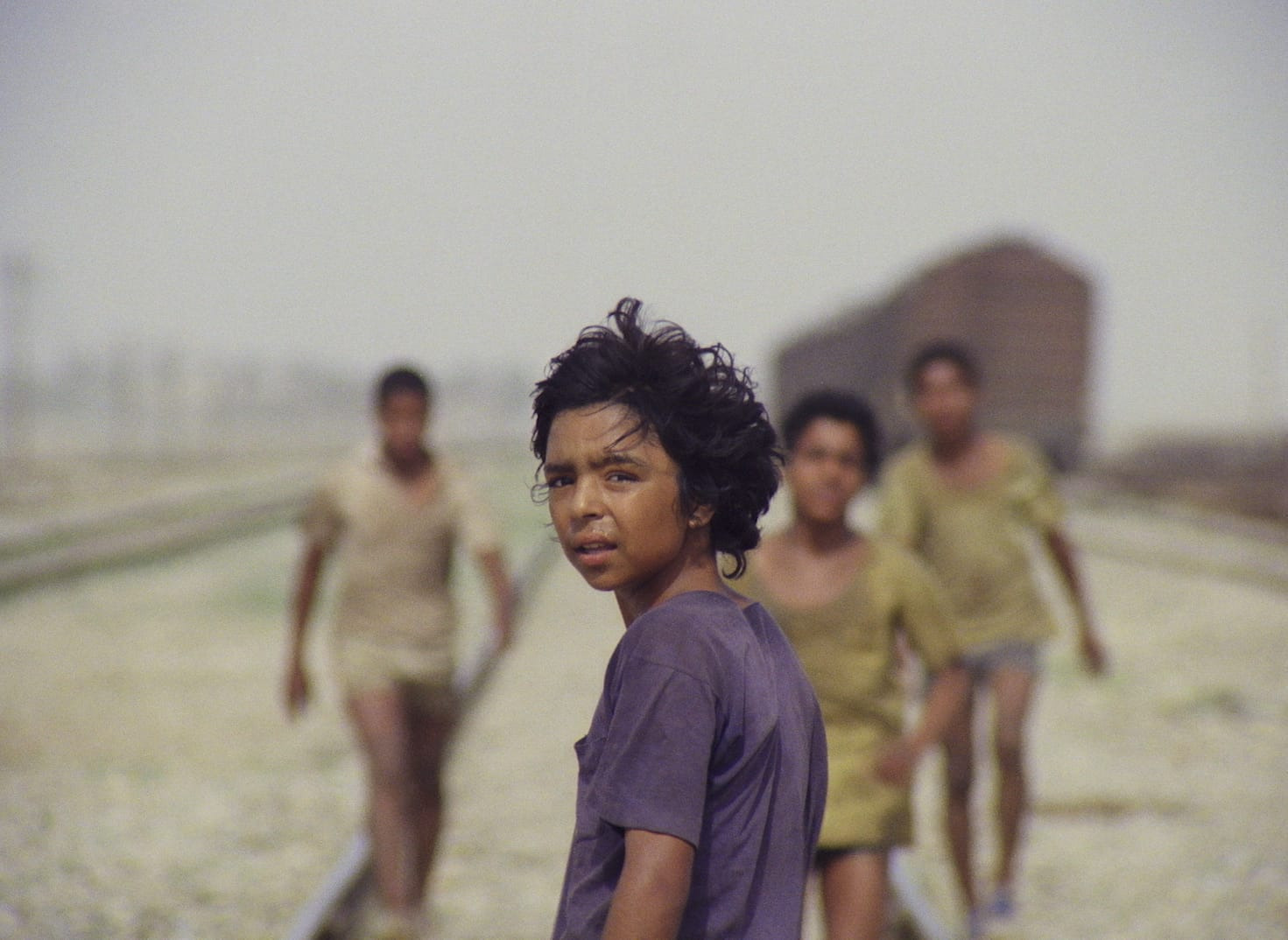
Amir Naderi’s The Runner (Davandeh, 1984) is one of the defining works of 1980s Iranian cinema. It was among the first Iranian films to attract significant international attention after the 1979 Revolution. Through the story of Amiro, an orphan living on society’s margins, Naderi crafts a film that transcends its local setting.
What begins as a struggle for survival becomes a universal story about perseverance, curiosity, and the search for one’s place in the world. Amiro, memorably portrayed by Majid Niroumand, survives by scavenging at a junkyard. He sells ice water, shines shoes, and collects empty bottles thrown into the sea from passing ships. His home is an abandoned shipwreck stranded on the shoreline. Symbols of wealth and modernity surround him, but only as someone else’s leftovers or as distant dreams he can never quite reach. Amiro inhabits a world where prosperity is visible everywhere, yet remains inaccessible.
The story contains strong autobiographical elements. Naderi himself was orphaned at the age of six and raised by his aunt in the southern Iranian city of Abadan. Both the city and the wider landscape of southern Iran would become central to his filmmaking.
The Interplay of Past and Present
The film’s temporal setting is deliberately ambiguous. On one level, it contains numerous cosmopolitan details associated with pre-revolutionary Iran: English-speaking foreigners, Western soft drinks, foreign music, and commercial ships arriving from abroad. Set against the backdrop of poverty, these elements highlight the social inequalities that characterized Iranian society at the time.
Several scenes show Amiro kneeling before Western foreigners, polishing their shoes for a few coins. These moments reflect broader disparities between wealthy industrial powers and the poorer segments of Iranian society. Although pre-revolutionary Iran was a regional power enriched by oil revenues, Naderi focuses on those who remained excluded from that prosperity.

At the same time, the film bears the marks of the era in which it was made. By 1984, the Iran-Iraq War had reached one of its most destructive phases, and Abadan had suffered extensive damage. As a result, The Runner could not be filmed in the city itself and was shot in various locations across southern Iran. While the war is never addressed directly, its presence lingers throughout the film. At one point, Amiro encounters a man who has lost a leg — an image contemporary audiences would have readily associated with wartime injuries. Likewise, shots of flames rising from an oil refinery can be read as echoes of the ongoing conflict.
Looking for a legal way to watch Iranian films?
Explore the complete guide →
The foreigners, ships, and Western imagery therefore do not represent the reality of Iran in 1984. Instead, they evoke Naderi’s memories of pre-revolutionary Abadan, blending personal recollection with the war-scarred present. The Runner unfolds across multiple temporal layers at once, existing simultaneously in memory and in contemporary reality.
This temporal ambiguity may also have allowed Naderi to avoid direct depictions of the war and the restrictions imposed by censorship. Earlier, he had directed the documentaries The Search (Jostoju, 1980) and Second Search (Jostoju-ye dovvom, 1981), both focusing on people who disappeared during the Revolution and the Iran-Iraq War. The films were subsequently banned by the Islamic regime.1 By relying on suggestion rather than explicit commentary, The Runner enabled Naderi to address the war indirectly.
Camera, Space, and Movement
The film’s visual design plays a crucial role in its impact. The coastal landscape is rendered in soft pastel tones, where pale yellow sand blends seamlessly with the blue of the sea and sky. Similar colors appear throughout the costumes. Amiro is always dressed in shades of blue, visually linking him to both the sky above and the blue airplane he admires so intensely. At the same time, his clothing creates a subtle contrast against the sandy shoreline that dominates much of the film.
Cinematographer Firooz Malekzadeh frequently employs telephoto lenses, observing the characters from a distance. This approach gives the film a detached, almost documentary-like quality. Yet the camera is not always static. Alongside sweeping pans, it employs subtle travelling shots that move toward Amiro during seemingly ordinary moments — washing clothes in an empty oil barrel or staring dreamily into the distance. These movements emphasize spatial depth and reinforce the idea that, in Naderi’s cinema, the environment is never merely a backdrop. It is inseparable from the people who inhabit it.

Some scenes begin with what appears to be an empty stretch of coastline. Only gradually does the camera’s movement reveal a group of children. The effect is striking: human beings become just one element within a much larger world. The sea and the beach exist independently of human presence.
Nature and humanity are often presented in tension, yet they share the same restless energy. Amiro feels as untamed as the crashing waves, the fire of the oil refinery, the passing trains, or the airplanes overhead. Nature, people, and machines are united by the film’s central motif: movement.
Movement is the source of Amiro’s vitality. He is constantly running, competing, shouting, and resisting the world around him. At first, however, this energy lacks direction. His cries are spontaneous acts of defiance, expressions of existence rather than instruments of change. Gradually, he comes to understand that his determination must be transformed into something more meaningful. Illiterate and eager to learn, he begins attending evening classes, studying the Persian alphabet so that he can read magazines about airplanes. His journey is therefore not only a struggle for survival but also a quest for knowledge and understanding.
In The Runner, Naderi tells the story of a boy learning how to channel his restless energy toward a purpose. From a deeply personal and locally grounded narrative emerges a film of remarkable universality — a moving reflection on human resilience, the desire for a better future, and the belief that even the longest run can eventually lead somewhere.
Iran Zamin Cinema is an independent, ad-free publication dedicated to Iranian cinema. Support the project on Buy Me a Coffee and help keep thoughtful essays and film analysis freely available.


Leave a Reply