
Today, Jafar Panahi is widely regarded as one of the world’s most important politically engaged filmmakers. That reputation has largely defined him since The Circle (Dayereh, 2000), his critique of the treatment of women in Iran, which was promptly banned by the Iranian authorities. From that point on, Panahi became increasingly associated with Iran’s underground cinema—a mode of filmmaking shaped by authoritarian rule, where films are produced without official permission and outside the reach of state censorship.
In the aftermath of Iran’s disputed 2009 presidential election, the Green Movement emerged to protest Mahmoud Ahmadinejad’s reelection. Panahi and fellow director Mohammad Rasoulof collaborated on a documentary about the protests, leading to their arrest. Both filmmakers were sentenced to a 20-year ban on directing films, writing screenplays, traveling abroad, and speaking with domestic or international media. In effect, the verdict forced them into a form of internal exile and pushed them toward underground filmmaking. This Is Not a Film (In Film Nist, 2011), co-directed by Panahi and Mojtaba Mirtahmasb, remains one of the defining examples of this clandestine filmmaking strategy.
Looking back at the beginning of Panahi’s career, however, reveals a rather different picture. His early films do not appear overtly anti-regime. Some scholars, including Hamid Naficy, have even suggested that his work could have been seen as broadly compatible with the post-revolutionary order.1 Between 1980 and 1982, Panahi completed his military service, during which he directed a documentary for Iranian television about the Iran-Iraq War. That fact alone, however, should not be taken as evidence of loyalty to the regime. After completing his service, he enrolled at the Tehran College of Cinema and Television. During the final stage of his studies, he worked as an assistant director to Abbas Kiarostami on Through the Olive Trees (Zire Derakhtan-e Zeytoon, 1994), a film that contains no explicit anti-regime message. A year later, Panahi made his feature debut with The White Balloon (Badkonak-e Sefid, 1995), another film that initially appears to be little more than a playful children’s story.
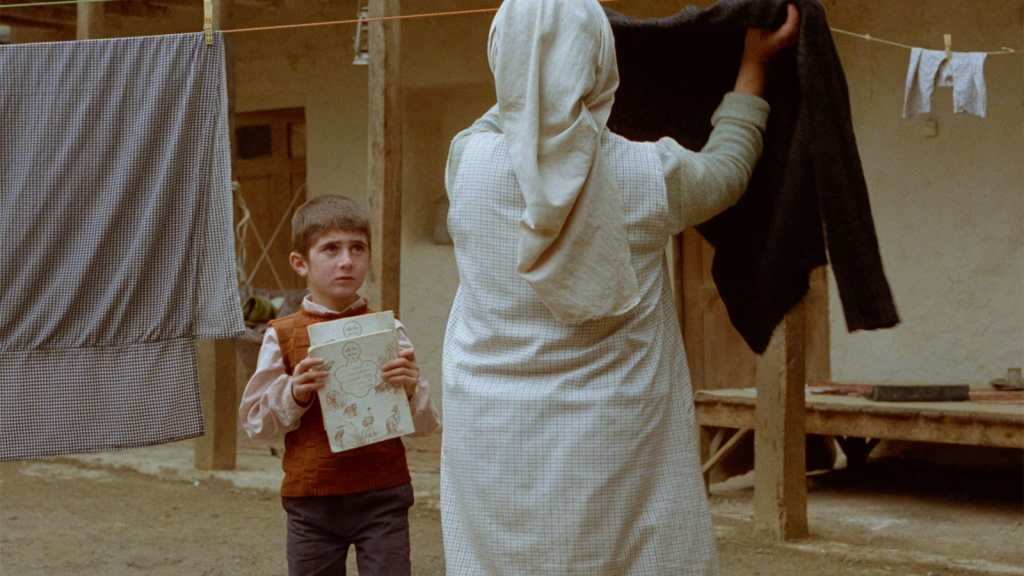
This raises an important question: did Panahi become a politically critical filmmaker only with The Circle, or were those concerns already present in his earlier work? A closer look suggests that The White Balloon is far from an innocent children’s film. It was made during the 1990s, when postwar reconstruction shaped both Iranian society and its cinema. Some films from the period promoted narratives of national renewal and social solidarity. Children’s films such as Bag of Rice (Kise-ye Berenj, dir. Mohammad Ali Talebi, 1997) and Children of Heaven (Bacheha-ye Aseman, dir. Majid Majidi, 1997) portrayed young protagonists who embodied sacrifice, responsibility, and commitment to family and community.
The White Balloon subtly disrupts that narrative. Its closing moments focus on a lonely Afghan boy who remains excluded from the community around him. His presence serves as a quiet reminder that Iran’s postwar vision of national unity did not extend equally to everyone.
Panahi develops this critical approach even further in his next feature, The Mirror (Ayneh, 1997). The film demonstrates that the political dimension of his cinema did not suddenly emerge in the openly confrontational works of the early 2000s. It was already present in his earliest films. Unlike The White Balloon, however, The Mirror challenges dominant ideological narratives not only through its story but also through its formal strategies, provocative parallels, and distinctive cinematic style.

From Children’s Cinema to Political Allegory
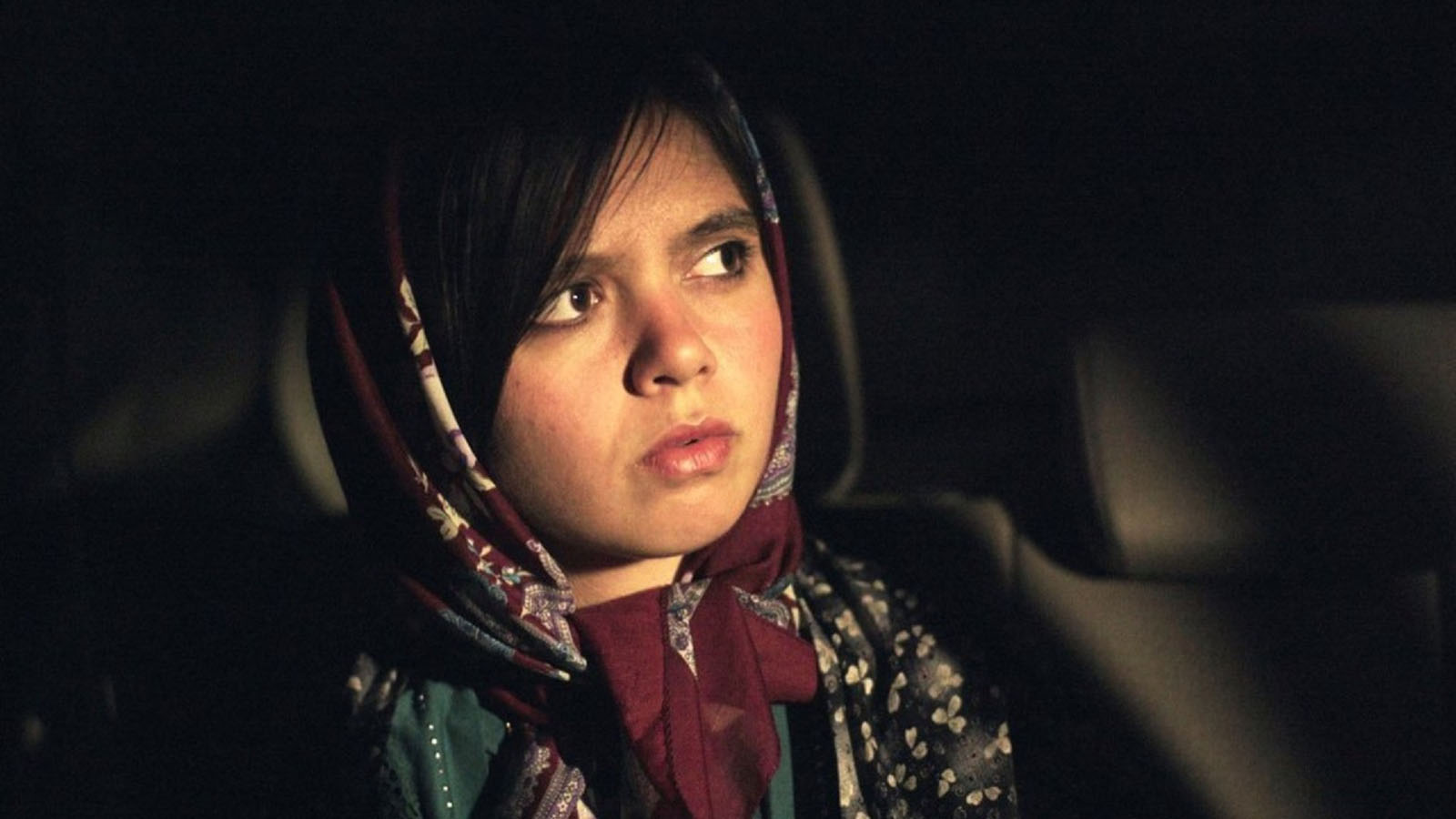
With The Mirror, Panahi adopts the minimalist framework that defines many Iranian children’s films: a young protagonist trying to solve a seemingly minor problem. At the same time, he radically reshapes that familiar structure through self-reflexive techniques and unexpected turns. The film begins conventionally enough. Mina’s mother fails to pick her up after school, so the young girl decides to make her way home alone. The narrative follows her journey using familiar cinematic devices that align the audience with her perspective on the city and the adults she encounters.
Halfway through the film, however, those established narrative and stylistic conventions collapse. Mina suddenly looks into the camera, breaks the fourth wall, and refuses to continue acting. A second camera then reveals Panahi’s crew, visibly unsure how to respond to this unexpected rebellion. Rather than stop filming, they begin secretly following Mina with a hidden camera mounted inside a car. What had previously been her journey as a fictional character now unfolds as her “real” attempt to get home—even though the entire situation remains carefully staged. Through the microphone Mina continues to wear, we hear both her voice and the sounds around her, allowing us to follow her conversations with strangers even when she disappears from the camera’s view.
The “real” Mina is noticeably more assertive than the character she had been playing. She insists on her independence, repeatedly claiming that she can manage on her own. Her refusal to continue acting becomes an act of rebellion against both adult authority and the conventions of storytelling itself. Film scholar Michelle Langford extends this reading by looking beyond the film’s famous metafictional moment. She argues that The Mirror functions as a political allegory. Rather than simply revising the conventions of Iranian children’s cinema, Panahi transforms them into a subtle yet sophisticated political satire.
One way he achieves this is through a series of carefully constructed parallels. Throughout the film, Mina’s journey is accompanied by radio broadcasts of a soccer match between Iran and South Korea, heard from passing cars and nearby shops. When she finally reaches her home at the end of the film, the radio announces Iran’s victory. The Persian word pirouzi (“victory”) refers both to the national triumph and to Mina’s own modest success in finding her way home. The parallel becomes even more pointed because Mina lives near Pirouzi Street. By equating her small personal achievement with the victory of the national team, Panahi introduces a subtle irony. Langford interprets this moment as a satirical commentary on the nation-building role assigned to post-revolutionary Iranian children’s cinema.
Other provocative parallels emerge through the film’s locations. Panahi repeatedly stages scenes in places whose names evoke the Islamic Revolution. Many of these sites were renamed after the revolution as part of the new regime’s symbolic remapping of public space. One of the most significant is Meydan-e Shohada (Martyrs’ Square), the site of the massacre known as Black Friday. During the revolution, roughly eighty demonstrators were killed there by the Shah’s forces, making the square one of the defining locations in the escalation of the uprising. Formerly known as Meydan-e Zhaleh (Dew Square), it was renamed Martyrs’ Square after the revolution. It sits at the intersection of Hefdah-e Shahrivar Street—named after the date of Black Friday—Mojahedin-e Eslam Street (Islamic Fighters), and the previously mentioned Pirouzi Street, where Mina lives. The names of Tehran’s streets preserve the memory of the revolution, embedding its history directly into the city’s geography.

At one of these symbolically charged locations, Mina enters a toy store and accidentally leaves behind her microphone. As the hidden recorder continues running, we overhear a conversation between the shopkeeper and a customer. The young man asks for pink ribbon for a wedding, but the shopkeeper says he has only black ribbon—an absurd response in the context of a toy store. He then suggests trying Martyrs’ Square if the customer wants other colors. As Langford observes, “It is therefore doubly ironic that the young man is advised to go to Shohada Square, a site directly associated with mourning and Black Friday, to find other colours, while the colour of mourning is associated with a toy shop.”2
Seen this way, Panahi’s experiment with the children’s film becomes a coded satire of the post-revolutionary project of constructing a new national identity. At the same time, many of these meanings remain accessible only to viewers familiar with Tehran’s history and urban geography.
The film’s political allegory is expressed not only through its narrative and symbolic references but also through its style. Once Mina leaves the film crew behind, the second half abandons the continuity editing associated with classical Hollywood cinema. Instead of guiding the viewer through carefully controlled cuts, the hidden camera observes events from a distance. Mina herself enjoys a freedom unavailable to the camera. As a child, she can move through Tehran with remarkable ease. The camera, concealed inside a car, is constrained by traffic, blocked by police, and deprived of the mobility that editing would normally provide.
Sound is similarly restricted. Technical problems occasionally interrupt the transmission from Mina’s microphone, causing her to disappear not only from view but also from hearing. Langford argues that these limitations point to “the limited and limiting possibilities of the camera in Iranian cinema, which cannot be freely omniscient.”3 In this sense, The Mirror turns its own formal constraints into an allegory for the restrictive conditions under which Iranian filmmakers are forced to work.

The Origins of Panahi’s Underground Filmmaking
Michelle Langford’s reading of The Mirror challenges the assumption that Panahi’s political cinema began with the openly confrontational films of the early 2000s. Instead, it suggests that the underground aesthetic associated with his later work was never simply a response to the filmmaking ban imposed in 2009. It was already a defining feature of his artistic practice. His clandestine films therefore represent less a break than a continuation of ideas and strategies that had been present from the beginning. Even in his earliest work, Panahi developed subtle ways of questioning dominant ideological narratives. While The White Balloon complicates the postwar ideal of national unity primarily through its narrative, The Mirror expands its critique through symbolic parallels, self-reflexive devices, and formal design. Although the film was produced legally within Iran’s official film industry, it already displays many of the characteristics commonly associated with underground cinema.
The Mirror also reminds us that political filmmaking does not have to rely on explicit criticism or direct engagement with contemporary events. Its political force can emerge through the transformation of familiar narrative conventions, the creative use of film form, and the construction of allegorical meanings that expose tensions beneath what appears to be a simple story about a child trying to find her way home. In that sense, The Mirror is not only an innovative reimagining of the Iranian children’s film. It is also one of the earliest and clearest expressions of Panahi’s enduring commitment to using film form itself as a vehicle for political reflection.
Iran Zamin Cinema is an independent, ad-free publication dedicated to Iranian cinema. Support the project on Buy Me a Coffee and help keep thoughtful essays and film analysis freely available.

- Hamid Naficy, A Social History of Iranian Cinema: Volume 4, The Globalizing Era (Durham and London: Duke University Press, 2012), 129-130. ↩︎
- Michelle Langford, Allegory in Iranian Cinema: The Aesthetics of Poetry and Resistance (London: Bloomsbury Academic, 2019), 100. ↩︎
- Michelle Langford, Allegory in Iranian Cinema: The Aesthetics of Poetry and Resistance (London: Bloomsbury Academic, 2019), 91. ↩︎

Leave a Reply