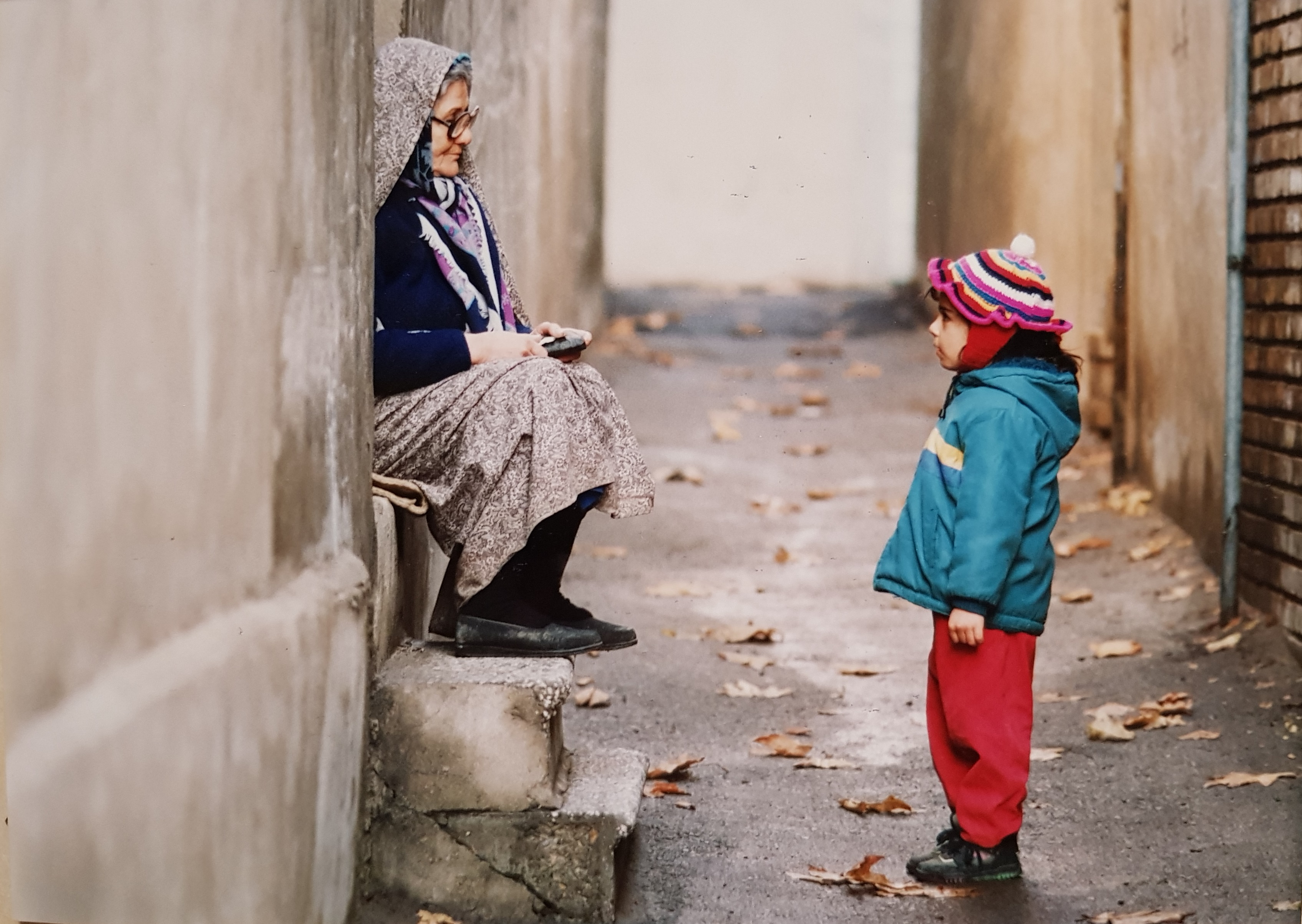
This article examines Mohammad Ali Talebi’s cinema through everyday urban life and the beauty of nature, engaging with ideas by Paul Schrader. It analyzes The Boot (Chakmeh, 1992), Bag of Rice (Kise-ye Berenj, 1997), and Willow and Wind (Bid o Bad, 1999), showing how children’s stories reveal spiritual depth, ethical awareness, and subtle tensions between reality and compassion.
The Czech Iranologist Jan Rypka once wrote in his History of Persian and Tajik Literature (1956): “From time immemorial to the present, history shows that the Iranian is a profoundly inward (‘spiritual’) being. […] This is clearly reflected in poetry, deeply infused with mysticism, where the Iranian’s vivid inclination toward religious speculation comes alive. It is also one of the reasons why Iranians have always loved their poetry: they find themselves in it.”1
While contemporary Iranian society has, to a large extent, moved away from this characterization, its influence hasn’t entirely disappeared. Many films produced in the decades following the Iranian Revolution still resonate with it. Filmmakers drew on religion, poetry, and mysticism, transforming tradition into a distinctly modern, auteur-driven cinematic language. As historian Michael Axworthy observes, “[Iranian] cinema shows the enduring greatness, the potential, the confidence, and the creative power of Iranian thought and expression.”2 Some critics even interpret Iranian filmmakers as modern-day Sufi poets—successors to the unorthodox Islamic mysticism Rypka alludes to.
At the same time, it would be misleading to view this tendency as merely an extension of Persian tradition. Both pre- and post-revolutionary Iranian modernist cinema reveal clear affinities with Italian neorealism and the French New Wave. In the films, poetry, and photography of Abbas Kiarostami, one can also trace the influence of Japanese haiku and the work of Yasujiro Ozu. In several post-revolutionary works, social realism merges with an aesthetic approach that Paul Schrader famously defined as the transcendental style. Although Schrader’s book Transcendental Style in Film: Ozu, Bresson, Dreyer (1972) may now seem dated from the perspective of contemporary film studies, it still offers a useful framework for understanding many Iranian films of this period. Films in the transcendental style employ a distinctive formal strategy to evoke the sacred—or what Schrader calls the “Wholly Other”—typically within a specific cultural context.
At first glance, the children’s films of Mohammad Ali Talebi might seem like simple moral tales designed to encourage altruism. They focus on Iran’s lower social classes—referred to in Persian as mosta’zafin (the deprived or disadvantaged)—and call for compassion and solidarity with the weak, the ill, and the disabled. As a child, Talebi attended the Institute for the Intellectual Development of Children and Young Adults (known as Kanoon), which became a key incubator for Iran’s modernist cinema in the 1970s and 1980s. His debut, the puppet film City of Mice (Shahr-e Mushha, 1986), co-directed with Marzieh Boroumand, followed the popular TV series School of Mice (Madrese-ye Mushha, 1981–1984), whose songs became widely known across Iran. A technically more refined sequel, City of Mice 2 (2014), was later directed by Boroumand alone.
More revealing than the Mice series, however, is Talebi’s live-action work. His internationally acclaimed films featuring child protagonists—The Boot, Bag of Rice, and Willow and Wind—blend elements of social and poetic realism. I would argue that beneath their seemingly straightforward moral narratives, Talebi constructs a subtler transcendental style. Beyond their clear ethical messages, these films can convey a sense of transcendence to attentive viewers. Talebi develops this style within the framework of his own cultural identity. Just as the films of Ozu reflect Zen traditions and the work of Robert Bresson is shaped by Christianity, Talebi’s cinema—much like Persian poetry—is imbued with a mysticism rooted in love and nature.
The Boot: Redemption from Physical Reality
Like Kiarostami, Majid Majidi, and Jafar Panahi, Talebi tells deceptively simple stories in which ordinary objects take on unusual value. In The Boot, the protagonist Samaneh is a young preschool girl who accompanies her mother each morning to a small tailoring workshop where she works. They live alone in a poor neighborhood in southern Tehran. The girl’s absent father likely died in the recent Iran-Iraq War. As winter approaches, the mother buys her a pair of red rain boots. The excited girl puts them on right in the store. On the way home, she falls asleep on the bus, one boot slips off, and disappears under a seat. The narrative then follows the lost boot as it passes through a chain of seemingly random encounters. Ali—a disabled boy from the neighborhood who has only one leg—decides to help Samaneh and sets out to find it.
A documentary-like style is key here. Talebi uses real locations and non-professional actors drawn from the environments he depicts. He shoots in southern Tehran, long seen as a poorer counterpoint to the affluent north. Interior scenes in the family’s modest one-room apartment unfold in long, observational takes, allowing partially improvised performances to play out naturally. In these moments, the camera patiently follows the restless child as she creates small, harmless chaos. Repeated shots of Tehran’s dense traffic establish the rhythms of everyday urban life.
Talebi’s observational approach recalls the work of pre-revolutionary director Sohrab Shahid Saless. In films A Simple Event (Yek Etefaq-e Sade, 1974) and Still Life (Tabiat-e Bijan, 1974), Shahid Saless used repetition and variation to express a bleak worldview. His characters are trapped in routine and shaped by unjust social structures. A similar attention to the mosta’zafin—the socially disadvantaged—is evident in The Boot. Samaneh’s mother initially hopes to buy warm winter shoes, but when she realizes she can’t afford them, she settles for rubber boots. The girl’s constant longing for toys and other small comforts reflects a child’s natural desire for a better material life.
At the same time, Talebi doesn’t stop at social determinism; he also emphasizes the limits of the human body. Ali, with his missing leg, becomes a visible emblem of physical hardship. Moving awkwardly on crutches, he stands in contrast to the hyperactive Samaneh, highlighting the fragility and constraint of the body. Samaneh herself is instinctively protective of her own physical being. In one scene, she is approached by a woman carrying a sheep’s head in her bag. Not realizing it is meant for the traditional dish kaleh pacheh, the girl panics and cries out: “Don’t eat me—my meat is bitter!”
While this moment humorously underscores human corporeality, Talebi ultimately reveals himself as a humanist, an idealist, and a mystic. Hope plays a central role in his films. Unlike the more determinist vision of Shahid Saless, Talebi suggests that both social and physical limits can be transcended. The lost boot does not move through the story purely by chance or human impulse. Its journey—from the bus driver who finds it, to a homeless scrap collector, and eventually to Ali—feels guided less by randomness than by fate.

Equally subtle is Talebi’s use of color as a structuring device. Beyond the obvious motif of the red boots, color operates consistently across the film. The opening credits feature an animated sequence of a child’s imagination: a reddish pink boot containing three spinning pinwheels in green, yellow, and blue. Similar colors reappear later in the tailoring workshop, where fabrics fill the space. When we eventually see the dump where the boot is lost, the similar palette resurfaces. Through this controlled repetition, Talebi imposes an implicit order onto an otherwise naturalistic world.


Talebi’s poetics can be partly understood through the lens of Schrader’s theory of the transcendental style. Schrader identifies a key dialectic between everyday, mundane, emotionally restrained reality and moments of disparity—instances of compassion or morally exceptional behavior that disrupt the ordinary. These moments suggest that life might be more than everyday existence. In The Boot, the weight of social and physical determinism is counterbalanced by human kindness and the suggestion of a hidden order. This tension points beyond material reality toward something deeper—toward the transcendent.
Still, this tension alone is not enough. According to Schrader, transcendental style culminates in what he calls a stasis: a final, frozen moment in which the closing image becomes almost icon-like. This kind of abrupt ending became a hallmark of post-revolutionary Iranian cinema, visible in the works of Kiarostami, Talebi, Majidi, and Panahi.
In The Boot, this final stasis is prepared by several key scenes. Ali learns that the homeless man found the missing boot but took it to the dump. On his way there, the boy is frightened by an aggressive dog and throws the second boot at it—the one Samaneh’s mother had given him in case it might help. The boot lands on the ground in front of the black dog, and Ali is suddenly unable to retrieve it. Then, unexpectedly, rain begins to fall, driving the dog away and allowing him to continue. At the dump, he searches for the lost boot—an effort that seems futile to his friend. Yet in the final scene, we see that he has succeeded. Ali returns both boots to Samaneh. She bursts into joyful excitement, jumping and celebrating. But when she turns back to thank him, he is gone. He has vanished without a trace, even from the nearby alley.
Ali’s sudden disappearance—ending in a fixed shot of the empty alley—infuses the film’s conclusion with a mystical aura. Samaneh cannot comprehend how he could vanish so quickly. This final stasis draws its power from earlier motifs: the black dog blocking his path, the seemingly “miraculous” rainfall, and the “impossible” recovery of the boot from the dump. In this moment, the boy appears redeemed from physical reality. The film suggests that Ali ceases to exist as a body and persists instead as an idea—an embodiment of a higher law of love.
Bag of Rice: Empire of the Mind
The Boot was made just four years after the end of the Iran-Iraq War, a conflict that had deeply damaged Iran’s economy and everyday living conditions. At the same time, the shared experience of war fostered a sense of unity and compassion. Akbar Hashemi Rafsanjani assumed the presidency and launched a period of postwar reconstruction. He focused especially on the mosta’zafin—the country’s poorest citizens—framing reconstruction as a way to improve their living conditions. Films like The Boot, along with many Iranian works of the 1990s, reflect this broader cultural mood, foregrounding themes of suffering, empathy, and hope.
This tendency becomes even more pronounced in Bag of Rice, where Talebi develops national and Islamic motifs more explicitly. The film follows the unlikely pair of an elderly woman, Masoumeh, and her young neighbor Jeyran, who helps her carry a heavy sack of rice. The story once again unfolds in southern Tehran, but poverty is less central than in The Boot. There are subtle signs of improved living conditions—for instance, the presence of a howz (a small courtyard pool typical of traditional Iranian homes). Jeyran’s father is present this time, though largely absent in practice, preferring work over family responsibilities.
The central conflict arises not from economic hardship but from strained family relations. Masoumeh’s adult son refuses to help his mother with her shopping. The film gently encourages young viewers to feel compassion for the elderly. Left with no other option, Masoumeh turns to Jeyran—yet the child, like the frail woman herself, struggles with the physical burden.
The relationship between Masoumeh and Jeyran builds a clear contrast between old age and childhood. On their way, Jeyran notices a child whose cap falls to the ground. She runs after the mother to return it, leaving Masoumeh behind, breathless and unable to keep up. The scene highlights the contrast between youthful agility and the vulnerability of an aging body. Talebi reinforces this contrast in small moments: when Masoumeh drops her glasses into a street gutter and children help retrieve them, or when she refuses pistachios because she can no longer chew them without teeth.
In the transcendental cinema of Bresson and Ozu, everyday life is typically marked by emotional restraint, only to be disrupted by moments of unexpected compassion or moral intensity—what Schrader calls disparity. These moments hint at the presence of the transcendent. In Bag of Rice, however, the balance is reversed. Acts of kindness are not rare interruptions but a dominant force within the narrative. Characters confronted with their physical limitations repeatedly encounter empathy. Collective solidarity culminates in a bus scene: when the sack tears open and rice spills across the floor, fellow passengers offer plastic bags and help gather it. Later, a group of schoolchildren assist Masoumeh and Jeyran by carrying the filled bags to the next stop.
This motif of collective care becomes part of a broader national narrative—one that draws on both Iran’s pre-Islamic and Islamic heritage. Historian Axworthy famously described Iran as an “empire of the mind.”3 At the height of its power, Persian civilization exerted influence through its thinkers and poets, and even today its shared culture connects ethnically and linguistically diverse communities. Talebi uses collective kindness to evoke this ethical dimension of Iran’s cultural identity. In one striking image, Jeyran, Masoumeh, and the schoolchildren carrying bags of rice pass in front of a relief inspired by the ancient city of Persepolis. The relief depicts guards from the Achaemenid era, when Persia reached the peak of its imperial power. The juxtaposition of modern-day helpers with ancient figures suggests a continuous national spirit running through history.

Still, references to the Achaemenid past are relatively rare. Talebi places greater emphasis on Islamic motifs, aligning the film with the cultural climate of the 1990s. The memory of sacrifice during the war with Iraq had strengthened religious feeling and a sense of obligation toward Islam. When Masoumeh asks a man who helped transport her rice on his motorcycle how she can repay him, he replies simply: “Pray for me.” At other moments, religious thinking is treated with gentle irony. When Masoumeh hesitates to take Jeyran to the park, the girl playfully warns her: “Anyone who doesn’t take me to the park will burn in hell!” The line softens religious rigidity through humor rather than reinforcing fear.
At the center of the film’s symbolic universe is rice itself—a staple of Iranian cuisine, commonly purchased in large quantities, just like in the film. By the end, however, rice takes on a sacred dimension. During a Shi’a ritual, women prepare sholezard, a traditional saffron rice dessert associated with the month of Ramadan. The dish is consecrated with prayers or blessings, and then distributed among neighbors as an act of communal giving—a way of praying for others.

In the final sequence, Jeyran participates in this ritual. Notably, she is no longer dressed in her sporty jacket but wears a chador appropriate for the ceremony. This sudden shift in costume signals an inner transformation, marking the culmination of her journey alongside Masoumeh. She delivers a bowl of sholezard to an elderly neighbor, who blesses her: “May you live to old age.” The film concludes with a frozen image—a moment of stasis—as the girl offers the bowl. In this final tableau, youth meets old age, blessing meets gratitude, and, on a deeper level, life meets death. Throughout the story, characters have helped one another in practical, material ways. In the end, the community becomes spiritually unified through ritual, as rice is transformed from a basic necessity into a sacred symbol.

Willow and Wind: Awe and Fear of Nature
Like the early films of Kiarostami, The Boot and Bag of Rice dwell on hardship. Kiarostami’s child protagonists often find no comfort in the harsh environments of school, work, or home. By contrast, although Talebi’s films also depict suffering among the mosta’zafin, they are not dominated by hostility. Compassionate figures repeatedly step in to help. Willow and Wind, however, marks a shift. Here, the surrounding world is no longer gently supportive but instead takes on a harsher, more indifferent character. It feels closer to the cinema of Shahid Saless or early Kiarostami.
This tonal change may partly stem from the involvement of Kiarostami as screenwriter, bringing with him both a heavier emotional register and his characteristic sensitivity to nature. The setting also changes: the film moves away from Tehran’s urban neighborhoods to the lush, forested landscapes of northern Iran. In Talebi’s rendering, natural elements form a kind of orchestration—birdsong persists against the force of the wind, suggesting a fragile but persistent harmony.

The story centers on Kouchakpour, a boy who broke a classroom window during a soccer game. His strict teacher gives him an ultimatum: fix it by evening or face expulsion. His classmates, though partly responsible, mock his predicament. Isolated and desperate, the boy tries to replace the glass but lacks the money. His father, burdened by debt and low-paying work, cannot help. One of the few moments of kindness comes when the father of a classmate, Reza, lends him the needed money. Kouchakpour buys the glass and sets off on a risky journey—one that is soon complicated by a violent windstorm.
The film was shot in the subtropical province of Gilan, known for its dense greenery and humid climate. Talebi foregrounds nature through the perspective of Reza, a newcomer whose family recently moved from central Iran. During class, Reza is more captivated by the sound of rain than by the teacher’s math lesson. His classmates cannot understand his fascination; they don’t know that in his desert hometown, rain was a rare event. Talebi repeatedly reinforces this fascination with nature through visually captivating shots: glass with raindrops running down it, or touched by willow leaves from the tree whose hollow Kouchakpour later uses as shelter from the rain. These moments recall the photographic work of Kiarostami.


Running parallel to the boy’s struggle is a portrait of nature that is both beautiful and cruel. Kouchakpour’s primary conflict is not with society but with the natural world itself. Carrying the fragile pane of glass, he must battle strong winds and wade through a swollen stream, constantly on the verge of failure. Willow and Wind presents nature as both treacherous and awe-inspiring. Using the language of Rudolf Otto, it becomes a mysterium tremendum et fascinans—something at once terrifying and irresistibly compelling. For Reza, enchanted by the “miracle” of rain, nature inspires wonder. For Kouchakpour, it provokes anxiety and fear. Yet, as Otto suggests, both responses are part of the same encounter with the sacred.
Kouchakpour ultimately manages to bring the glass to school, only for it to fall from the window frame and shatter due to the wind. After a brief moment of silence, he resolves to try again—to retrace his entire journey. The futility of this decision is underscored by the film’s careful handling of time. Earlier, the glazier warned that his shop would close at 7 p.m.; when Kouchakpour first left, it was already 5:30. By the time the glass breaks, the school clock shows 6:30. The trip has taken nearly an hour. Realistically, he now has at most thirty minutes to borrow money again and return—an almost impossible task.
And yet, because Talebi ends the film in a moment of stasis, this seemingly hopeless gesture is transformed. The final image is both unsettling and strangely hopeful, infused with a sense of the transcendent. In a wide shot, Kouchakpour runs along the horizon. The spinning wind turbine reveals that he is now moving with the wind, rather than against it as before. This shift suggests a newfound harmony with the forces that once opposed him—echoing Reza’s earlier affinity with the rain. A boy on a motorcycle enters the frame, beckons Kouchakpour to join him, and together they continue in the same direction as the wind. Technology—the motorcycle and the wind turbine—aligns symbolically with nature’s power.

The transcendental style of Willow and Wind thus differs from both Bresson’s austere resistance to bodily and social limitation and Ozu’s serene acceptance of the world. In its final stasis, Talebi’s film paradoxically holds both positions at once: it affirms the persistence of struggle while simultaneously suggesting a mysterious, almost inexplicable reconciliation with existence.
Iran Zamin Cinema is an independent, ad-free publication dedicated to Iranian cinema. Support the project on Buy Me a Coffee and help keep thoughtful essays and film analysis freely available.

- Jan Rypka, Dějiny perské a tádžické literatury (Praha: Nakladatelství Československé akademie věd, 1956), 75. ↩︎
- Michael Axworthy, A History of Iran: Empire of the Mind (New York: Basic Books, 2016), 293. ↩︎
- Michael Axworthy, A History of Iran: Empire of the Mind (New York: Basic Books, 2016), 293 – 294 ↩︎

Leave a Reply