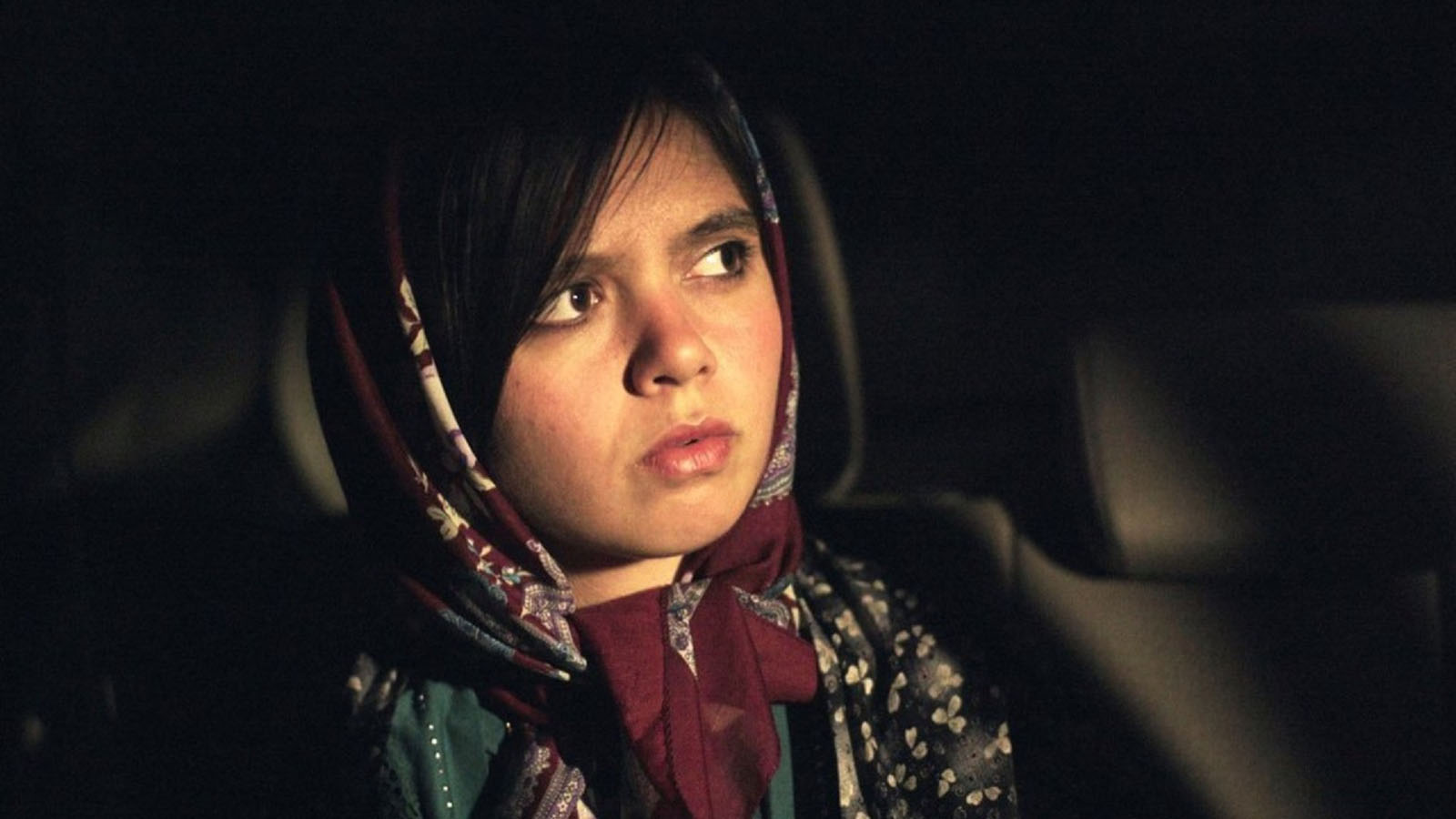
Jafar Panahi is not only a courageous activist but also an inventive artist and an open-minded thinker. His film 3 Faces (Se rokh, 2018) is a striking example of how the Iranian director blends social critique with satire, irony, and compelling cinematic craft. It offers a powerful reflection on freedom and expression.
Political and Social Context
Shortly after Iran’s 2009 presidential election, the so-called Green Movement emerged in protest against the disputed reelection of Mahmoud Ahmadinejad. Panahi, working alongside Mohammad Rasoulof, took part in making a protest film about the movement. A few months later, while serving as jury president at the Montreal World Film Festival, Panahi publicly voiced his support for the demonstrations. Standing before an audience, he held up a photograph of Neda Agha-Soltan, whose shooting in the streets of Tehran—caught on camera and widely circulated by the media—turned her into one of the most powerful symbols of the protests. Panahi’s and Rasoulof’s open opposition to the regime led to their arrest. Both filmmakers were eventually released from custody, but sentenced to six years of house arrest and banned for twenty years from making films, writing screenplays, traveling abroad, or speaking to Iranian or foreign media.1

Despite being effectively exiled within his own country, Panahi managed to make several low-budget films illegally, beginning with the documentary This Is Not a Film (In film nist, 2011). In it, he reflects on the despair of house arrest. We watch him eat breakfast, feed his pet iguana, run into blocked websites, and revisit scenes from his earlier work. The film, made clandestinely, premiered at Cannes. Around that time, a media hoax took off claiming the movie had been smuggled out of Iran on a USB drive hidden inside a cake. Panahi later debunked the story in an interview: “The story of the cake is nothing but a lie. It has nothing to do with me, and I have no idea who said that and how that story started.”2
Although he couldn’t attend in person, Panahi received the Carrosse d’Or at Cannes for This Is Not a Film, an award recognizing innovative filmmaking and courageous artistic defiance. In the years that followed, he made a series of mock-documentary fiction films in which he plays a version of himself as a social actor: Closed Curtain (Pardeh, 2013), Taxi (2015), 3 Faces (Se rokh, 2018), and No Bears (Khers nist, 2022). For all their wit and playfulness, these films are shot through with the director’s personal frustration.

It’s fair to call Panahi “one of the most important filmmakers of the 21st century.”3 The political charge of his work aligns him with figures associated with Iranian social cinema—Mohsen Makhmalbaf, Asghar Farhadi, and Rasoulof among them. Aesthetically, however, his work is closest to Abbas Kiarostami’s slow, contemplative cinema of the car and the landscape. Both directors developed minimalist production and stylistic habits through their early work in children’s cinema. Panahi began his career as Kiarostami’s assistant, and Kiarostami wrote the screenplays for Panahi’s The White Balloon (Badkonak-e sefid, 1995) and later Crimson Gold (Tala-ye sorkh, 2003). Panahi’s Taxi clearly echoes Kiarostami’s Ten (Dah, 2002), which unfolds entirely inside a car—but Panahi pushes the political dimension further, focusing on his own internal exile and the realities of censorship in Iranian cinema.
Offside and the Question of Feminism
Recurring themes in Panahi’s politically engaged cinema include women’s subordinate status, restrictions placed on filmmakers, and the social exclusion of the poor. His outspoken anti-regime stance sometimes tempts critics into reductive readings that overlook the complexity and aesthetics of his work. A case in point is sociologist Hasan Gurkan’s interpretation of Offside (2006), which frames the film as an alternative medium giving voice to discriminated women.4 The premise is drawn from reality: women in Iran are barred from attending men’s soccer matches. Panahi’s film follows a group of female fans who disguise themselves as men to sneak into a stadium, only to be discovered by soldiers, detained, and held in a temporary enclosure outside the arena.

By treating Offside primarily as a “media voice” for women, Gurkan overlooks the fact that Panahi devotes just as much attention to male discrimination. The young soldiers guarding the women are not acting out of ideological loyalty to the regime; they’re trying to avoid extended military service so they can return home and support their impoverished families. Any interpretation that reduces the film to the perspective of a single group inevitably misses its other layers of meaning. More broadly, reading art merely as a medium for information privileges content over form and ignores its aesthetic value.
Panahi’s films, I would argue, cannot be reduced to voices for minorities or marginalized groups. They’re compelling precisely because of their allegorical strategies and playful mystifications, where fiction and reality blur. Even Hidden (2020), a documentary that critiques patriarchy directly, resists functioning as a simple “voice” for women. In this film, Panahi works with musical intensity as deliberately as he does with social critique. His films are shaped not only by what they say, but by how their aesthetic choices invite reflection on cinema’s place in the Islamic Republic—offering distance, perspective, and at times even transcendence.
Satire of Patriarchy and Misogyny in Panahi’s 3 Faces
Panahi made 3 Faces under severe production constraints as his fourth illegal film. Once again, he returns to the status of women in Iranian society, a subject he had already addressed in The Circle (Dayereh, 2000) and Offside. He casts the well-known actress Behnaz Jafari as herself. Jafari receives a disturbing video from Marziyeh, a young woman from a small village, who explains that she repeatedly tried—and failed—to reach out for help. Her family has forbidden her from studying acting, and Jafari’s intervention was her last hope. Trapped and desperate, Marziyeh appears to take her own life on camera.

Shaken, Jafari travels with Panahi to a mountainous village in East Azerbaijan Province to find out whether the suicide was real or a provocation meant to bring her there. Jafari and Marziyeh represent two generations of Iranian women. A third, older generation is embodied by Shahrzad (born Kobra Saeedi), an actress and poet from the pre-revolutionary era. Ostracized by society, she lives in isolation on the edge of the village and appears only as a distant silhouette. The villagers mockingly call her a motreb—an insulting term roughly equivalent to a low-status performer. The character’s fate mirrors Shahrzad’s real life: after the revolution, she lost much of her property and was forced into financial hardship. The film also alludes to post-revolutionary shifts in Iranian cinema through a reference to Behrouz Vossoughi, a pre-revolution star who emigrated to the U.S. and became persona non grata at home. Just as Vossoughi was not allowed to return to Iran, Panahi himself was forbidden to leave the country while making 3 Faces.
The film’s social critique rests largely on its satire of rural life, portrayed as holding blindly to absurd traditions while refusing to confront deeper problems. Marziyeh describes the village as a place without logic. The only system that functions—temporarily, at least—is a set of comically rigid traffic rules created to manage a narrow dirt road. It doesn’t take much decoding to see the village as a parody of the Islamic Republic itself. 3 Faces is a transparent satire of post-revolutionary power structures that marginalize women and artists. What complicates these seemingly clear themes is the way Panahi presents them.
Contemplation and Social Resistance
Film critic Naomi Keenan O’Shea notes how Panahi’s aesthetic evolves in 3 Faces: “Although the narrative centers around complex issues of oppression and misogyny, 3 Faces is the most visually beautiful and free-feeling work Panahi has produced in many years.”5 His earlier post-persecution films were confined to closed spaces—a house (This Is Not a Film), a villa (Closed Curtain), a car (Taxi)—embodying frustration and distrust. 3 Faces is his first banned-era film to escape those confines. O’Shea describes this shift in the director’s style:
“The undulating landscape of the village’s surrounding fields evokes the broadened scope of Panahi’s visual aesthetic, with Amin Jafari’s cinematography lending a richer depth of field and spatial fluidity than was afforded by the limited settings of the earlier films.”6
The rural landscape feels folkloric, almost mythical: “Ironically, in a village which bears all the claustrophobic weight of traditionalism and isolation, Panahi has made his most spacious and breathable film yet.”7

Panahi seems to use landscape and atmosphere to gain distance from the bitterness of his subject matter. Alongside the striking locations, he relies on an observational style and irony to create detachment. This contemplative impulse recalls Kiarostami, particularly Taste of Cherry (1997), where a man seeking assistance with suicide is overshadowed by the winding road and the surrounding landscape. Irony and humor lighten the anxiety, and Kiarostami ultimately breaks the illusion by revealing the film crew. Panahi adopts a similar strategy in 3 Faces, shifting attention away from suffering toward the mythic quality of the land. Through passivity and irony, he invites viewers to see painful realities from a reflective distance.
This dynamic becomes clear in the contrast between Marziyeh’s rebellion and Panahi’s passivity. Marziyeh’s video suicide can be read as a radical form of protest, echoing real-world acts of defiance by Iranian women—from Sahar Khodayari’s self-immolation in 2019 to the hair-cutting and headscarf-burning during the 2022–2023 “Woman, Life, Freedom” protests. Yet 3 Faces does not escalate into revolutionary rhetoric. Panahi positions himself as a passive observer, unwilling or unable to reshape the world.

That tension is reflected in the film’s style. Marziyeh’s opening message is a handheld smartphone selfie, emotionally raw and urgent. What follows is shot in an observational mode, the camera retreating into neutrality. A car scene after the opening unfolds in a single, unbroken take lasting over ten minutes. For several minutes, the camera simply watches Jafari react to the video while Panahi sits offscreen. Only later does the frame move, slowly panning in a full circle—an echo of Kiarostami’s slow cinema and a stark contrast to Marziyeh’s engaged voice.


Panahi’s passivity extends to his on-screen behavior. When Jafari goes to visit the ostracized Shahrzad, Panahi stays behind in the car, waiting as dusk slowly falls. He listens to a recording of Shahrzad’s poetry, exhausted. When Jafari later asks him what he plans to do, he replies: “Nothing. I’ll sleep in the car. I’m really tired.”

This resignation differs sharply from the desperation evident in This Is Not a Film, where Panahi performs scenes from an unrealized screenplay, signaling his refusal to accept the court’s verdict. In 3 Faces, he appears calmer, sometimes almost apathetic—a man who disagrees with reality but no longer fights it directly. One might even read this as an acknowledgment that, in Iran, open rebellion has increasingly become the domain of women—a notion Panahi would later revisit in It Was Just an Accident (Yek tasadof-e sadeh, 2025).
Panahi’s Meta-Irony
3 Faces doesn’t just mock patriarchal rural life; it also pokes fun at the urban, progressive Jafari. Early on, Panahi receives a call from a production assistant complaining about “crazy Jafari,” who has abruptly abandoned shooting. Meanwhile, Jafari paces nervously around the car, trying to convince herself that Marziyeh’s suicide might be fake. Panahi likely suspects as much but says nothing, subtly manipulating events. When Jafari asks if she’s unknowingly part of one of his secret film projects, he offers no answer. His secretiveness deepens when he speaks to villagers in Azerbaijani—a language Jafari doesn’t understand—forcing her to trust him blindly.

This quiet provocation can be read as self-reflexive commentary on the director’s power and privileged knowledge during filmmaking, hinting that what we’re watching—despite its documentary feel—is still fiction. At the same time, Panahi’s teasing of his female protagonist functions as meta-irony: it’s unclear whether he’s undermining her or simply playing with perspective. This irony allows the film to approach women’s discrimination with subtlety, avoiding the rigidity that plagues some contemporary feminist cinema.
Yet the film’s final moments suggest Panahi’s own doubts about the effectiveness of calm contemplation and irony. Marziyeh attempts a desperate escape, implicitly validating rebellion and showing that Panahi is not as calm as he seems. The bleak implication—that her escape is doomed and countless other girls remain trapped—undercuts any faith in cinema’s healing power, a faith Kiarostami embraced fully. 3 Faces ultimately leaves us wondering whether Panahi’s passivity signals acceptance—or merely masks the hopelessness of an artist living in internal exile. From this perspective, 3 Faces truly is a bitter comedy.
Iran Zamin Cinema is an independent, ad-free publication dedicated to Iranian cinema. Support the project on Buy Me a Coffee and help keep thoughtful essays and film analysis freely available.

- Hamid Naficy, A Social History of Iranian Cinema: Volume 4, The Globalizing Era (Durham and London: Duke University Press, 2012), 328-330. ↩︎
- https://www.hollywoodreporter.com/movies/movie-news/jafar-panahi-cannes-interview-it-was-just-an-accident-1236221113/ ↩︎
- https://mubi.com/notebook/posts/jafar-panahi-heads-in-a-new-direction-with-3-faces ↩︎
- https://www.globalmediajournal.com/open-access/cinema-as-an-alternative-media-offside-by-jafar-panahi.php?aid=54891 ↩︎
- https://mubi.com/notebook/posts/jafar-panahi-heads-in-a-new-direction-with-3-faces ↩︎
- https://mubi.com/notebook/posts/jafar-panahi-heads-in-a-new-direction-with-3-faces ↩︎
- https://mubi.com/notebook/posts/jafar-panahi-heads-in-a-new-direction-with-3-faces ↩︎

Leave a Reply