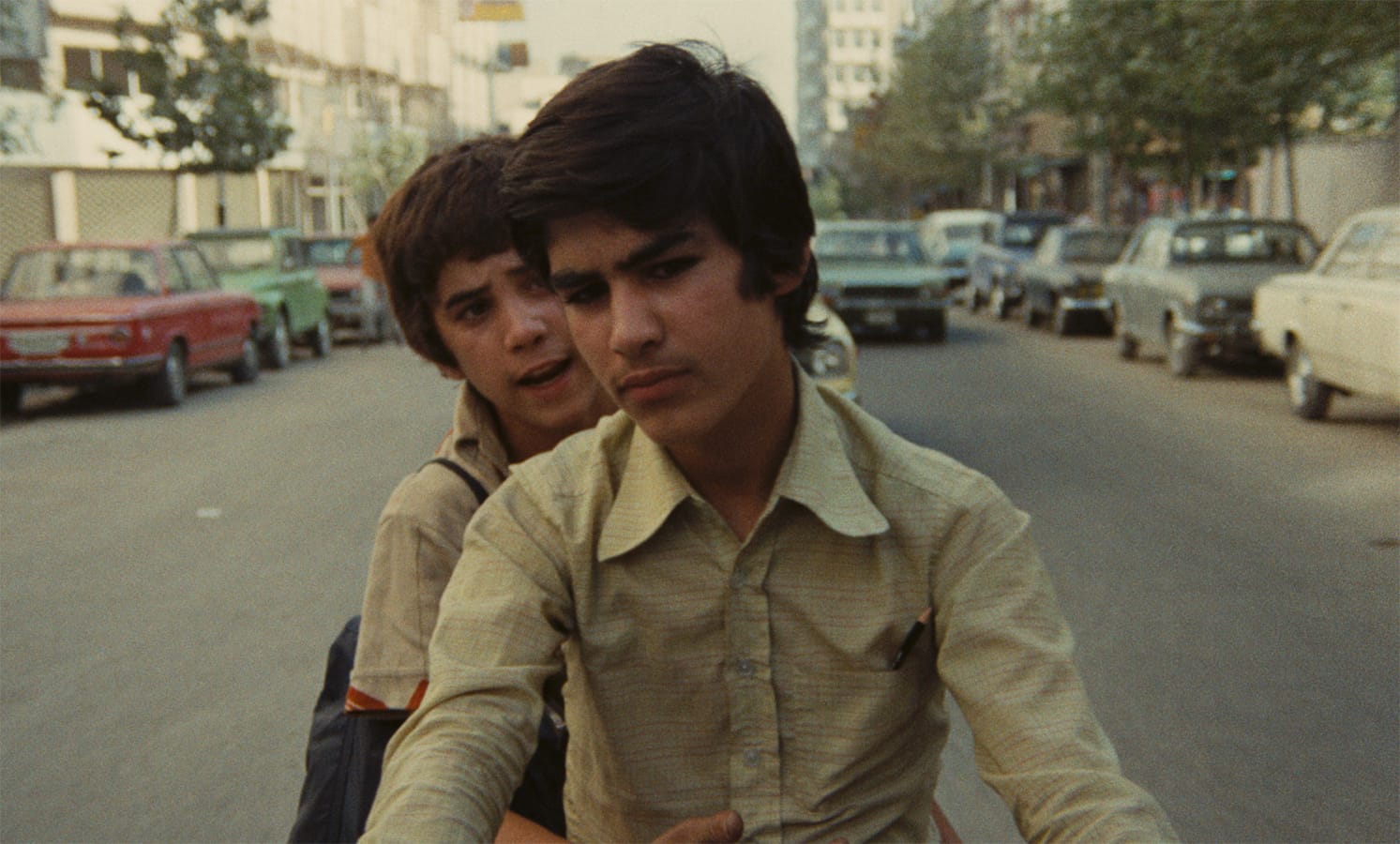
The rise of Iranian art cinema was closely tied to the children’s films Abbas Kiarostami made between the 1970s and the 1990s. Within Iranian filmmaking, he was one of the directors who helped define the distinctive character of children’s cinema in Iran. In a 1995 interview, Kiarostami described his approach to choosing subjects this way: “I’d rather look at the positive side of daily life than the negative, which makes me sleepless and nervous. So I look around and select the things that seem to me the best.”1 For viewers familiar with his early films about children, however, that statement may come as a surprise — these works are far removed from any optimistic vision of the world.
In his study of Iranian children’s cinema, Amir Ali Nojoumian argues:
“The concept of childhood and adolescence has been constructed and reconstructed significantly depending on the drastic sociopolitical changes of contemporary Iranian society. A study of Iranian children’s and young adults’ cinema provides a significant and profound panorama of the way children and young adults have been represented, defined, redefined, constructed, and reconstructed based on the dominant ideological discourses of their time.”2
For that reason, Kiarostami’s pre-revolution films must be understood in the context of the social transformations that shaped their creation. The so-called White Revolution, launched in 1963, was intended to modernize Iran, but it also dramatically widened the gap between rich and poor. Nojoumian suggests that the recurring image of children resisting tradition can be read as a symptom of emerging modernity. At the same time, these children are also its victims. One consequence of the White Revolution was mass migration from rural areas into cities, where the children of migrant families often became cheap and exploited labor.
These social contradictions lie at the heart of Kiarostami’s pre-revolution films of the 1970s — Experience (Tajrobeh, 1973), The Traveler (Mossafer, 1974), and A Wedding Suit (Lebasi Bara-ye Arusi, 1976). Although the films were produced under the auspices of the Institute for the Intellectual Development of Children and Young Adults (Kanoon), their formal sophistication and thematic weight pushed far beyond the boundaries of conventional children’s cinema.
Experience: Loneliness and Desire in Tehran
In Experience, Kiarostami follows Mamad, an orphan from the countryside who works — and occasionally sleeps — in a photography studio in Tehran. At work, he is repeatedly subjected to humiliation and authoritarian treatment from both his boss and an older employee. Over time, the boy develops a platonic crush on a schoolgirl from a middle-class family whom he regularly encounters while wandering through the city. Hoping to move closer to her world, he even tries to get hired as a servant in her family’s home. Despite his initial optimism, he is ultimately turned away.
What appears at first to be a simple story is in fact a revealing portrait of the deep class inequalities within Iranian society at the time — especially the divide between the countryside and the rapidly modernizing city. Yet Kiarostami goes beyond social critique alone. Experience is also a delicate study of adolescence, loneliness, and first love. Faced with social injustice and daily humiliation, Mamad finds little comfort in reality and retreats instead into the realm of idealized romantic longing. By the film’s end, however, that idealism reveals itself to be painfully naïve.

Although the film centers on the psychology of a child protagonist, Kiarostami avoids subjective narration or overt visualizations of childhood imagination. The information the film provides about Mamad remains largely objective and observational. His emotions are fully exposed only in a handful of brief moments — primarily during encounters with the girl he loves. In most scenes, however, his inner life remains inaccessible.
The film’s highly observational style reinforces this distance. The camera often watches the boy from afar, frequently using telephoto shots as he moves through the city streets, giving the film an almost documentary-like quality. Another striking stylistic motif is Kiarostami’s use of double framing: characters are filmed through windows, doorways, or reflections in mirrors. In these compositions, the camera assumes the position of a detached observer. The absence of non-diegetic music and the emphasis on the authentic sounds of the city further strengthen the film’s objective tone. The viewer is immersed directly into the noisy, restless reality of urban life. Kiarostami’s early style — often described as neorealist — presents human beings as fundamentally absorbed by the material world surrounding them.
Looking for a legal way to watch Iranian films?
Explore the complete guide →
While the narrative primarily focuses on observing the child protagonist, it also leaves room for the presence of nature. In one scene, the characters are almost entirely obscured by a tree during a conversation. Yet the camera never adjusts the composition to reveal them more clearly or make the dialogue easier to follow. Instead, Kiarostami subtly allows the viewer’s attention to linger on the tree itself. Water functions as another recurring natural motif — flowing from taps or falling as rain — bringing an atmosphere of melancholy into the film.
Kiarostami’s treatment of emotion is particularly evident in two scenes. In the first, Mamad’s coworker deliberately knocks over a bucket of water. The boy sits down on a staircase while the camera simply observes him from a distance. A subsequent shot reflects his perception: the camera lingers on the spilled water before slowly panning toward the street, where the wind carries away a scrap of paper. Although the film briefly aligns itself with what Mamad sees, his emotional response remains suppressed. The next shot shows his face nearly expressionless. Kiarostami is clearly more interested in the physical reality of the surrounding world than in explicit psychological exposition.
This principle becomes even more pronounced in the film’s final moments. Standing at the door of the wealthy girl’s house, Mamad learns that he will not be hired by her family. Even though the viewer can assume the depth of his disappointment, the camera films him from above and at a distance, refusing access to his inner state. Once again, the film privileges external observation over psychological introspection. Critic Amir Soltani describes the scene this way:
“Mamad is suddenly facing a world far darker than his imagination and is forced to comprehend the harsh reality of class differences. […] Kiarostami preserves the boy’s dignity by concealing his face and yet, emphasizing his desperation at the rejection.”3
The restraint with which emotion is presented does not create emotional coldness or cynicism. On the contrary, it allows Kiarostami to portray a child cast into a hostile urban environment with remarkable sensitivity, while also leaving space for the viewer’s own empathy.
The Traveler: Dreams, Poverty, and Urban Modernity
Kiarostami’s next film from the 1970s, The Traveler, further develops the themes of social inequality between the provinces and the city, as well as the conflict between children and the adult world. Its protagonist is thirteen-year-old Qassem — a poor student but an obsessive soccer fan. His greatest dream is to leave his provincial hometown and travel to distant Tehran to see his favorite team play. To pay for the trip and the ticket, however, he first has to find money. As the film progresses, Qassem resorts to increasingly dishonest schemes, eventually even selling his own soccer goal.
Much like Experience, the child’s desire ultimately remains unfulfilled. After a long struggle, Qassem finally reaches Tehran, but the exhausting overnight journey leaves him so drained that he falls asleep in a city park. By the time he wakes up and runs to the stadium, the match is already over. The final shot strikingly echoes the ending of the previous film: the camera lingers from above on the lonely boy standing inside an empty stadium, once again refusing to explicitly convey his emotional reaction.

The divide between the provinces and the modern city is especially clear in a scene set at a public swimming pool in Tehran. Qassem tries to strike up a conversation with a city boy inside the facility while he himself remains outside, separated by a glass wall. Although he attempts to engage him, the other boy cannot hear him through the glass and soon begins to ignore him entirely. Modern urban life is accessible to Qassem only as a distant spectacle — something he can look at through a window but never truly enter or belong to. He remains unable to form an equal connection with his peers from Tehran.
Once again, Kiarostami presents a child growing up within the deeply divided social landscape of pre-revolutionary Iran. Yet Qassem is far from an idealized symbol of innocence. His behavior is often selfish and manipulative: first he steals money from his parents. Later, he uses a broken camera to pretend he is photographing younger classmates while fraudulently collecting money from them. Kiarostami softens these ethically troubling moments with touches of humor, preventing the film from slipping into simplistic moralizing.
Although the director maintains his characteristic documentary-like realism, he also introduces a relatively unusual element within his work: a dream sequence. While asleep, Qassem experiences a nightmare in which his classmates brutally beat him as his mother coldly watches her son suffer. The dream does not function as an escape into fantasy or safety, but rather as a heightened reflection of the harsh reality in which the boy lives. At the very moment the long-awaited soccer match is taking place in real life, Qassem descends into a dark vision of violence and abandonment.
This sequence ultimately confirms Kiarostami’s rejection of sentimentalized notions of childhood. At the same time, it allows the viewer to empathize with a suffering protagonist whose behavior might otherwise appear primarily selfish and unlikeable.
A Wedding Suit: Lost Innocence
In A Wedding Suit, Kiarostami returns to the world of small Tehran stores while continuing to explore themes of social inequality and childhood selfishness. The film’s central trio of boys can hardly be described as true friends. Ali works as an apprentice in a tailor’s shop, and it is through him that his “friends,” Hossein and Mamad, attempt to gain access to a newly made wedding suit. Each boy wants to use it for his own purposes — one hopes to impress a girl, while the other plans to wear it during a magic performance.
Unlike Experience or The Traveler, childhood ideals and grand dreams are no longer at the center of the story. Yet beneath the seemingly lighthearted farce about borrowing a suit lies a deeper reflection on poverty and social inequality. An important contrast is provided by the carefree boy from the middle-class family for whom the suit was originally made. What is completely ordinary for one social class becomes, for another, an almost unattainable object of desire.

The dynamic between the three protagonists functions as a chain of dominance. Mamad is the most aggressive and manipulative, followed by Hossein, while the timid and most innocent Ali occupies the lowest position. In one scene, Mamad relentlessly pressures Hossein to lend him money for food. After prolonged persuasion, Hossein finally gives in — only to turn around and pressure Ali in much the same way over the suit. The film reveals how cycles of pressure and manipulation reproduce themselves even among children.
On the surface, Ali appears to be the victim of his “friends,” but from a broader perspective all three boys emerge as victims of a deeply antisocial system. This becomes especially clear in a scene where Mamad is brutally beaten by his older brother. The sight of the bleeding child has an effect similar to Qassem’s nightmare in The Traveler: the viewer suddenly realizes that even an aggressive and selfish child is still trapped within a much larger cycle of violence and humiliation. Compared to the brutality of the surrounding world, his petty scams and manipulations begin to seem almost insignificant. It is no coincidence that the conversations between the adult shopkeepers resemble the boys’ own arguments. Kiarostami suggests that children’s behavior is ultimately nothing more than a reflection of the society in which they are raised.
In Kiarostami’s early films, being a victim of modernity does not simply mean working hard or living in poverty. It also means growing up in a society that forces individuals to adopt dishonest ways of surviving. In these films, reality always triumphs over desire. Ideals dissolve into illusions, dreams remain unattainable, or gradually disappear altogether.
The Evolution of Childhood in Iranian Cinema
During the 1980s and 1990s, Kiarostami gradually moved away from the “neorealist” style of his early films and toward the “poetic realism” that defines works such as Where Is the Friend’s House? (Khane-ye Dust Kojast?, 1987) or And Life Goes On (Zendegi va Digar Hich, 1992). His films of the 1970s portrayed children as figures trapped within a cold social reality. By contrast, his later work became increasingly open to themes of human solidarity, hope, and the quiet poetry of everyday life.
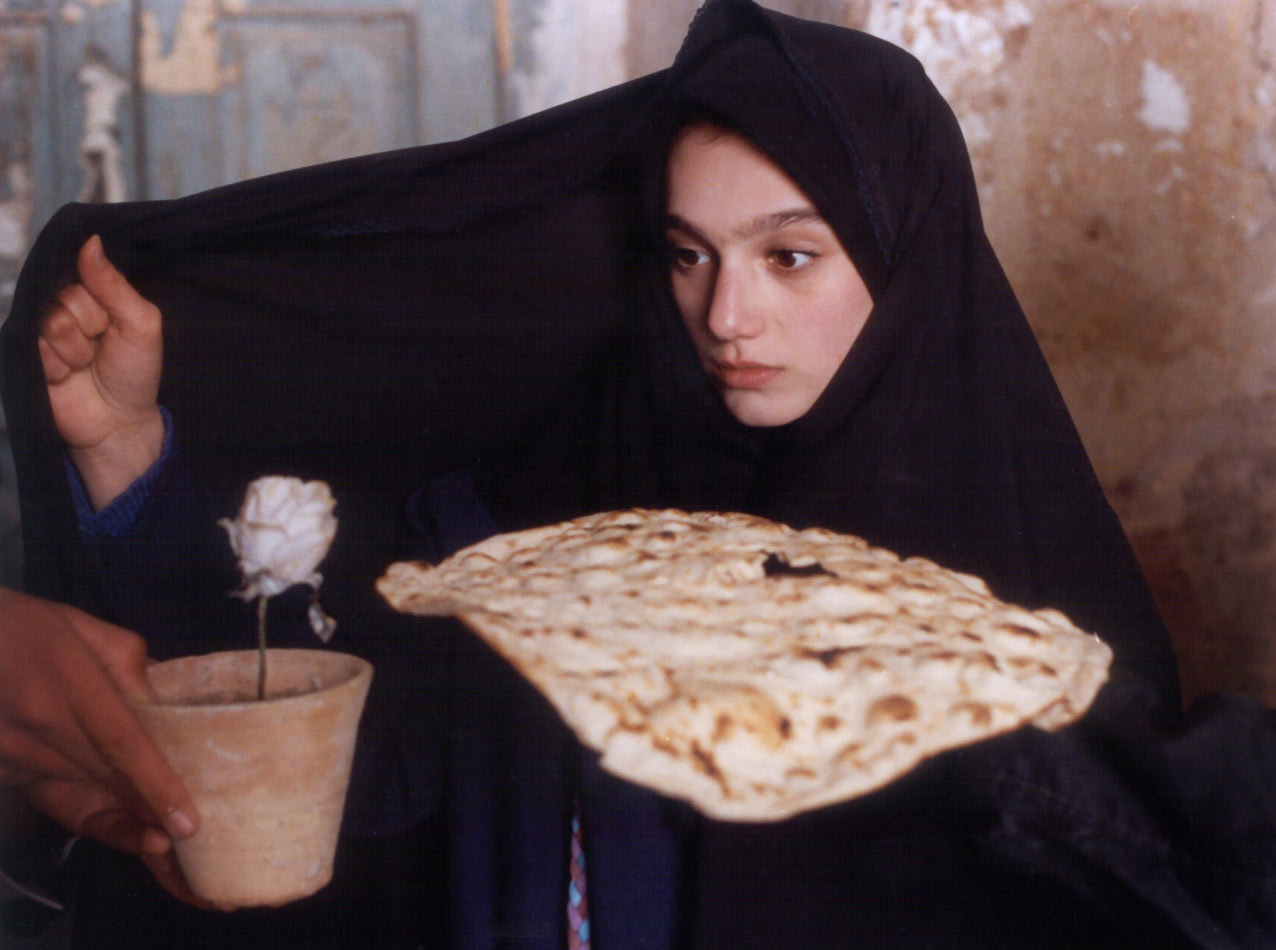
This shift is developed even further in the films of Majid Majidi, especially Children of Heaven (Bacheha-ye Aseman, 1997) and The Color of Paradise (Rang-e Khoda, 1999). In these films, a model of the “ideal child” gradually emerges — pure, morally uncorrupted, and spiritually grounded. Nojoumian connects this development to the historical context of the Iran–Iraq War. In the postwar atmosphere of the 1990s, themes of national reconstruction, reconciliation, and the search for a new social order moved to the forefront. According to Nojoumian, Iranian cinema was responding to the collective experience of war and suffering endured by society as a whole. Discussing Majidi’s films, he writes:
“Both these films revolve around the definition of childhood as the realm of pure innocence. Majidi’s religious inclinations prescribe an essentialist and idealist view of childhood in which children are depicted as godly individuals who have a revelatory rapport with heaven. […] Ali’s and Mohammad’s journeys are perfect illustrations of holy passion, suffering, compassion and of course, determination.”4
In this respect, Kiarostami’s pre-revolution films stand as an important counterpoint to the later idealization of the child protagonist. The children in Experience, The Traveler, and A Wedding Suit are not symbols of purity or moral innocence. They are isolated protagonists shaped by social inequality, violence, and the pressures of a rapidly modernizing society. Yet Kiarostami portrays their world neither sentimentally nor cynically. Rather than offering clear moral judgments, he presents an attentive observation of reality — one in which childhood desire is constantly colliding with the limits imposed by the surrounding world.
If you enjoyed this essay, please consider supporting my blog — either by making a donation on Buy Me a Coffee or by sharing it with others. Your support helps me continue creating meaningful content. Thank you!

- Pat Aufderheide, “Abbas Kiarostami, Real Life Is More Important Than Cinema: An Interview with Abbas Kiarostami,” Cinéaste 21, no. 3 (1995): 32. ↩︎
- Amir Ali Nojoumian, “Constructing Childhood in Modern Iranian Children’s Cinema: A Cultural History,” in The Palgrave Handbook of Children’s Film and Television, ed. Casie Hermansson and Janet Zepernick (Cham: Palgrave Macmillan, 2019), 279. ↩︎
- http://moviemezzanine.com/abbas-kiarostami-essay/ ↩︎
- Amir Ali Nojoumian, “Constructing Childhood in Modern Iranian Children’s Cinema: A Cultural History,” in The Palgrave Handbook of Children’s Film and Television, ed. Casie Hermansson and Janet Zepernick (Cham: Palgrave Macmillan, 2019), 290. ↩︎
Leave a Reply