
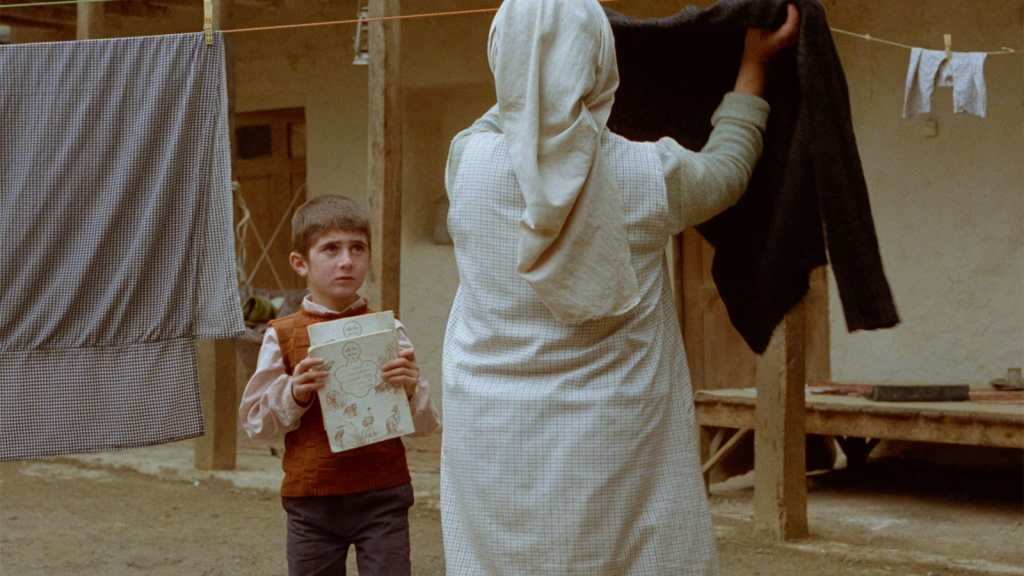
Abbas Kiarostami’s Where Is the Friend’s House? (1987) has fascinated me for years. This film, one of the most celebrated Kiarostami children’s films, tells a simple story—about a mix-up with school notebooks and a boy’s journey to a neighboring village to make things right—that carries unexpected depth and emotional power.
Below, you’ll find my very first video essay, in which I share three personal reasons why I believe this film is absolutely worth seeing. I hope this Abbas Kiarostami film review inspires you to explore the beauty and depth of Iranian New Wave cinema.
1. Little Big Adventure
The plot is simple, yet it creates a surprisingly strong sense of tension and offers a deeply immersive experience. The film speaks to a wide audience: from lovers of art-house cinema, to fans of children’s films, to those drawn to unconventional storytelling. Kiarostami’s style is minimalist, yet never cold—he draws the viewer deep into the narrative with quiet intensity.
2. The Poetry of the Iranian Village
The Iranian countryside holds a central place not only in Kiarostami’s work, but also in the broader tradition of Persian literature and cinema. Rural life was a frequent setting in pre-revolutionary Iranian films, such as The Cow (Dariush Mehrjui, 1969) and The Sealed Soil (Marva Nabili, 1977), as well as in the writings of Mahmoud Dowlatabadi and Gholam-Hossein Sa’edi. Kiarostami’s approach, however, is unique. Through his lens, the village becomes a space of contemplation, silence, and natural poetry. The beauty of his style and the authenticity of his work with non-professional actors create a poetic vision of everyday life.
3. The Altruistic Child
One of the film’s most powerful elements is its young protagonist—driven not by selfish desires, but by a sincere effort to help someone else. In Kiarostami’s and Amir Naderi’s pre-revolutionary films, child characters were often motivated by ego and personal needs. But in Where Is the Friend’s House?, we meet a new kind of character: a morally strong, sensitive, and empathetic boy. This shift marked a new direction for Iranian children’s cinema. In the 1990s, Majid Majidi developed this approach further in films like Children of Heaven (1997) and The Color of Paradise (1999), where young protagonists embody a sense of spiritual purity.
Iran Zamin Cinema is an independent, ad-free publication dedicated to Iranian cinema. Support the project on Buy Me a Coffee and help keep thoughtful essays and film analysis freely available.


Leave a Reply