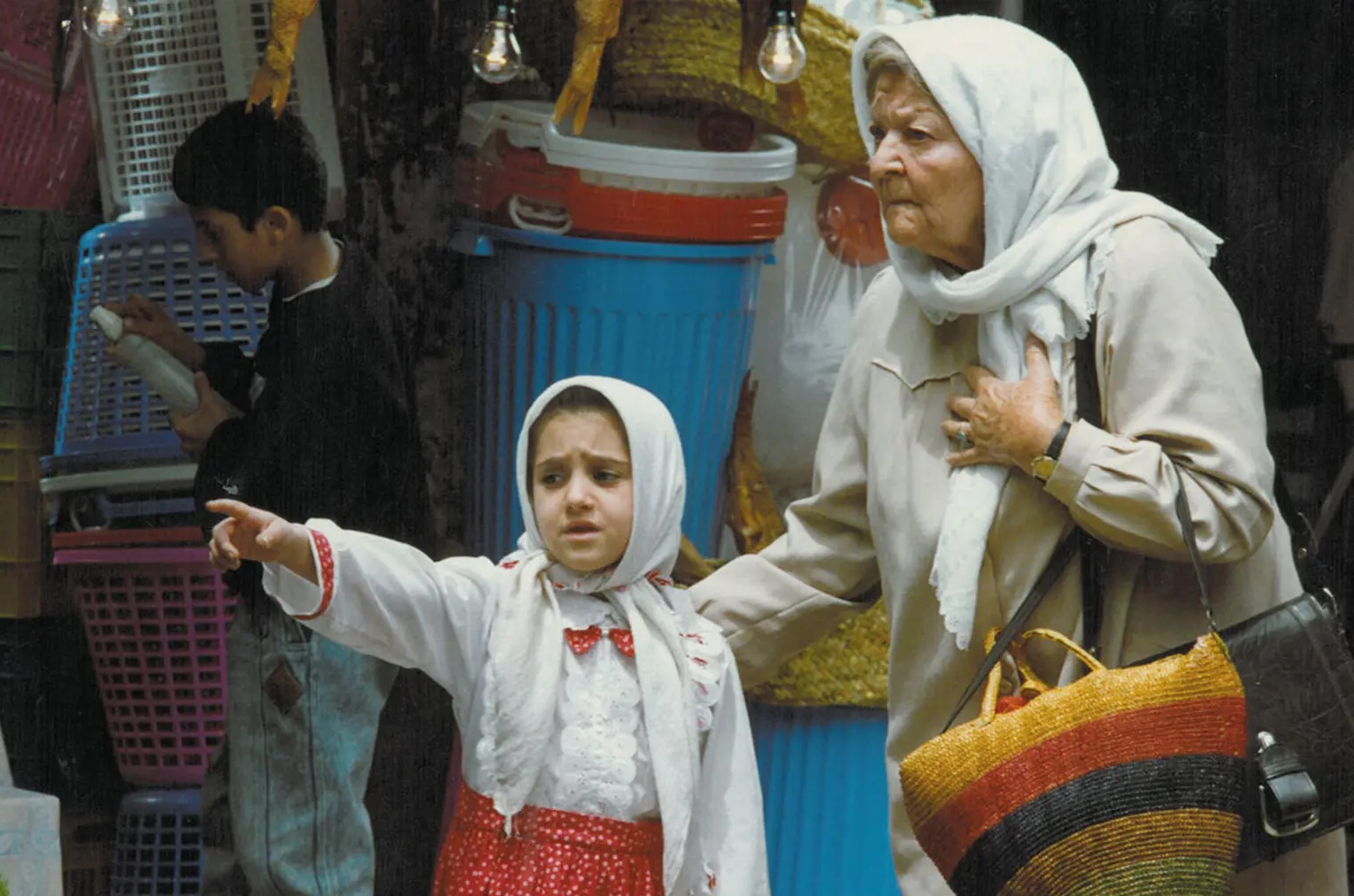
Jafar Panahi’s feature debut The White Balloon (Badkonak-e Sefid, 1995) demonstrates how much can be expressed through economical storytelling. What begins as a simple story about a young girl gradually unfolds into a portrait of urban Iranian society, where social divisions and unspoken boundaries lie beneath a veneer of everyday politeness.
The film follows a few hours in the life of Razieh, a young girl preparing for Nowruz, the Iranian New Year. Eager to buy a goldfish for the family’s festivities, she eventually persuades her mother to give her the money. On the way to the market, however, she accidentally drops the banknote into a street drain. With the help of her older brother, Razieh desperately searches for a way to retrieve it before the shops close. Through this deceptively simple premise, Panahi builds a vivid picture of daily life in the city and of a child’s unwavering determination to achieve her goal.
Unlike many of Panahi’s later works, The White Balloon is not primarily an overt political allegory. Even so, it stands apart from several other Iranian films centered on children that emerged during the 1990s. In the years following the Iran-Iraq War, ideas of national reconstruction and collective solidarity were prominent themes in Iranian cinema. Films from the period often emphasized family, cooperation, and social responsibility.
A useful comparison can be made with Majid Majidi’s Children of Heaven (Bacheha-ye aseman, 1997). In that film, the young protagonists struggle to correct a mistake that affects their family, and their actions are driven largely by a sense of duty toward others. Similar themes can be found in Bag of Rice (Kise-ye Berenj, dir. Mohammad Ali Talebi, 1997), where a young girl enthusiastically helps an elderly neighbor.
The White Balloon takes a different path. Razieh is not motivated by moral obligation or self-sacrifice. She simply wants something for herself. This seemingly trivial desire marks a significant departure from the dominant patterns of Iranian children’s cinema in the 1990s. Her persistence can be read in different ways: as a form of resistance to authority, but also as a kind of selfishness.
As Razieh moves through the city, her journey becomes a mosaic of different social classes and communities. Through careful observation and understated storytelling, Panahi captures the dynamics of everyday social life. Razieh repeatedly encounters adults, especially shopkeepers, whose behavior exposes subtle contradictions. They are polite and attentive toward customers, yet often dismissive or humiliating toward apprentices and assistants. Ordinary interactions acquire a quietly critical dimension.

The film is also structured around recurring radio announcements heard in shops throughout the city. These broadcasts count down the remaining hours until the arrival of the New Year. Gradually, Panahi builds tension toward the moment of the spring equinox — the exact instant when Nowruz begins. Anticipation of this transition lies at the heart of the holiday itself. For many Iranians, it is a moment traditionally shared with family and loved ones.
Panahi uses the countdown not only as a dramatic device but also as a reminder of a ritual experienced collectively across the country. Yet the film’s ending complicates this image of togetherness. While Razieh and her brother return to their family, the Afghan balloon seller who helped them recover the money remains outside the celebration. He is left alone, overlooked, and symbolically excluded from this moment of communal joy.
Beneath the surface of everyday harmony, The White Balloon suggests that social cohesion is neither natural nor universal. Some groups remain on the margins. When the film was made, millions of Afghan refugees were living in Iran, many having arrived during the Soviet-Afghan War and the years of conflict that followed. The final image of the Afghan boy serves as a quiet but powerful reminder that not everyone is included in the same vision of community.
In this way, what appears to be a modest children’s film becomes a subtle critique of both the social realities of its time and the dominant narratives that shaped Iranian cinema in the postwar era.
Iran Zamin Cinema is an independent, ad-free publication dedicated to Iranian cinema. Support the project on Buy Me a Coffee and help keep thoughtful essays and film analysis freely available.


Leave a Reply