Can a violent revolution create a better world? That is the question Iranian filmmaker Mohsen Makhmalbaf poses in A Moment of Innocence (Noon-o-goldoon, 1996). Yet the film’s inquiry extends beyond politics and society. It is also deeply personal. Through a return to his own youth, Makhmalbaf revisits his past without self-pity or self-condemnation, searching instead for understanding.
Born into the traditional, religious environment of southern Tehran, Makhmalbaf was influenced by the revolutionary ideals of his generation. At seventeen, he stabbed a police officer serving under the Shah and was subsequently imprisoned. Produced on a modest budget and reportedly written during a single airplane flight, A Moment of Innocence stands as both an act of self-reflection and a remarkable generational statement. By blurring the boundaries between reality and fiction, Makhmalbaf constructs an alternative version of history—one in which revolutionary violence is replaced by gestures of empathy and solidarity.
The Road to A Moment of Innocence
To fully appreciate A Moment of Innocence, the film must be viewed within the broader trajectory of Makhmalbaf’s career, which closely mirrors the evolution of his worldview. Film historian Hamid Naficy divides Makhmalbaf’s work into three distinct phases. During the 1980s, he evolved from an ideologically Islamic filmmaker into a socially critical director. In the 1990s, he embraced a more humanist and relativist perspective, a transformation that reached its fullest expression in A Moment of Innocence. After 2000, his work increasingly aligned with political dissent.1
Makhmalbaf emerged as a filmmaker from the Islamic Art and Thought Center (Howzeh-ye Andisheh va Honar-e Eslami), an institution founded in 1979 by a group of religiously committed artists under the umbrella of the Islamic Propaganda Organization.2 During the early years of the Iran–Iraq War, the center primarily produced films focused on the conflict. Most of Makhmalbaf’s films from this early Islamic period were produced under the auspices of the organization, including Two Blind Eyes (Do Cheshm-e Bisu, 1984), Fleeing from Evil to God (Este’azeh, 1984), and Boycott (1986).
A major turning point came with The Cyclist (Bisikelran, 1989). While its emotional intensity still recalls Makhmalbaf’s earlier films, its story of an Afghan refugee struggling to survive points toward the socially engaged phase that would define much of his later work.
By the time he directed Time of Love (Nobat-e Asheqi, 1991) and Once Upon a Time, Cinema (Nasser al-Din Shah, Aktor-e Cinema, 1992), Makhmalbaf’s worldview had become markedly more pluralistic. Time of Love, filmed in Turkey, presents three different versions of the same love triangle. The characters repeatedly exchange roles, inviting viewers to reconsider infidelity from multiple perspectives. His affectionate tribute to Iranian cinema, Once Upon a Time, Cinema, similarly reflects a desire to revisit and reassess the past. The film pays homage to pre-revolutionary Iranian cinema, honoring filmmakers and movie stars whose work had been partly forgotten. It was within this broader movement away from absolute truths and toward a multiplicity of viewpoints that A Moment of Innocence emerged.

Makhmalbaf’s pursuit of artistic independence reached a new stage in 1996 with the founding of the Makhmalbaf Film House (Khaneh-ye Film-e Makhmalbaf), a family-run production company and film school. Based in the family house, the collective became a creative hub where his wife Marziyeh Meshkiny and his daughters Samira, Maysam, and Hana developed their filmmaking skills while actively participating in production.
To finance A Moment of Innocence, Makhmalbaf took out a personal loan. Before granting the film distribution approval, Iran’s Ministry of Culture demanded that several scenes be removed. Rather than comply, he chose to preserve the film intact. With the support of his family, he sold the family house and used the proceeds to repay the debt himself.3 The decision allowed him to maintain his independence from state funding and censorship, a principle that would remain central to his career.
Bread, Flowers, and Revolution
A Moment of Innocence is a playful act of cinematic deception. Framed as the making of a film, it blurs the line between documentary and fiction in ways that recall broader trends in Iranian cinema, most notably Abbas Kiarostami’s Close-up (Nema-ye nazdik, 1990). The police officer whom Makhmalbaf stabbed during the Shah’s era reunites with the director to recreate the incident on camera.
To play his seventeen-year-old self, Makhmalbaf casts an idealistic young man who dreams of becoming “the father of humanity” and saving the world from social injustice. The boy’s earnest convictions remind the director of his own revolutionary zeal. Like many members of his generation, Makhmalbaf was inspired by figures such as Che Guevara4 and believed that overthrowing the Shah’s authoritarian regime would bring a better future for Iran. The coexistence of the filmmaker and his younger on-screen double creates a doubled reality and makes time appear relative.
Looking for a legal way to watch Iranian films?
Explore the complete guide →
The narrative unfolds through two parallel storylines. In one, Makhmalbaf prepares the actor playing his younger self. In the other, the former officer coaches the young actor cast as him. These narrative strands do not always align chronologically. At certain moments, the editing jumps from one storyline to the other, sending the viewer a few minutes back in time. The film’s recurring bazaar corridor, circular in shape, reinforces this sense of temporal looping. Characters move through the space while the two narrative threads intersect in unexpected ways.
At one point, the actor playing the young officer hurriedly places a flowerpot in a wall niche. When he returns moments later, it has disappeared. Only later, from the perspective of the other storyline, does the film reveal what happened: a woman passing through the bazaar casually took the flower.

In another scene, time is disrupted more radically. Makhmalbaf and the actor portraying his younger self visit the director’s cousin and her daughter. The daughter politely offers the young man a cup of tea. What begins as a conversation between strangers gradually transforms into a dialogue from the 1970s. Without a cut, a change of setting, or even different performers, the boy slips into the role of the young Makhmalbaf while the girl assumes the role of his cousin. Past and present coexist within a single shot. The result is a striking sense of temporal relativity. Two different moments occupy the same cinematic space, revealing the fluid and unstable nature of memory.
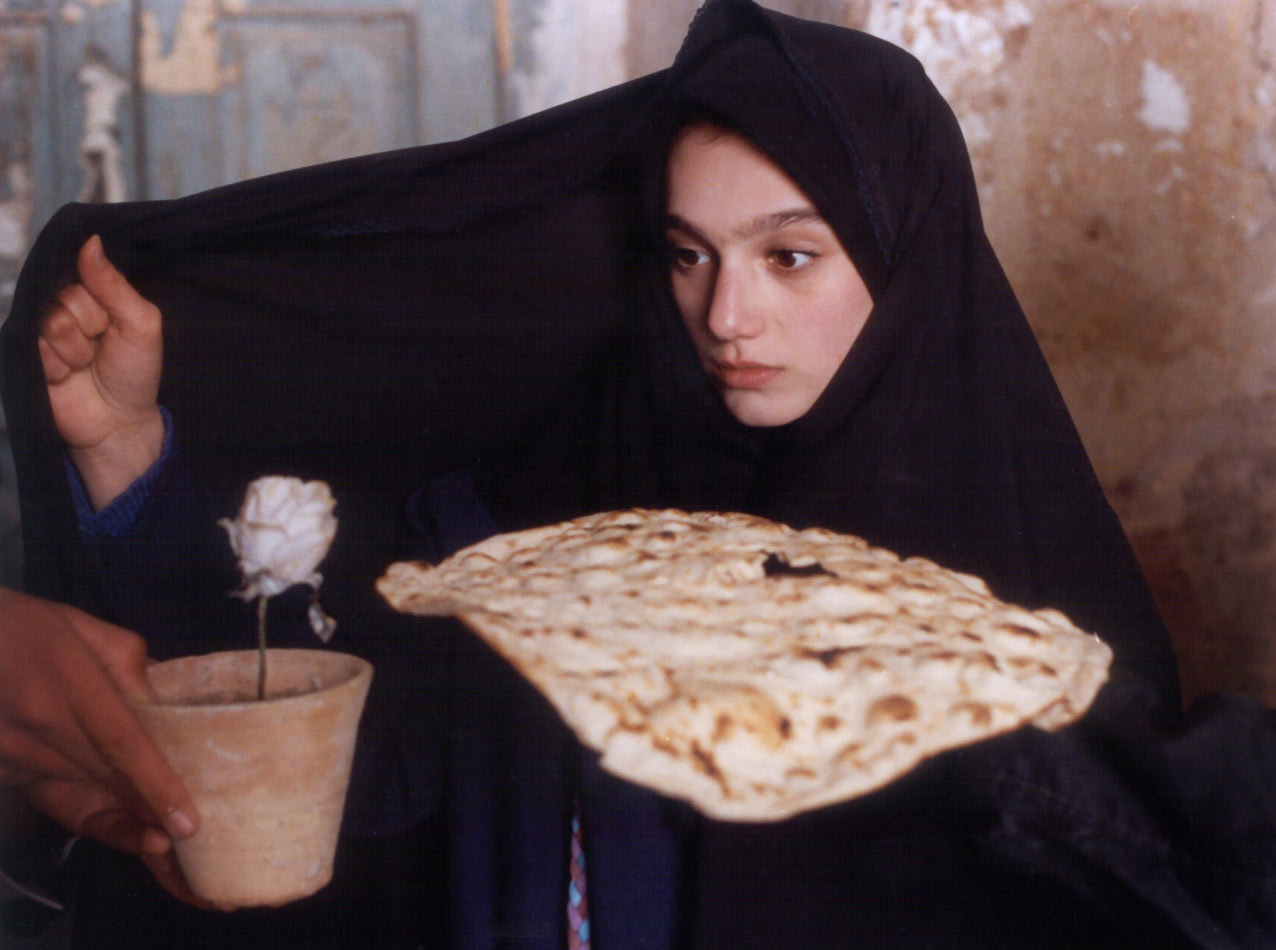
As filming progresses, reality begins to drift away from the director’s plan. The young actors assert their own agency and create a new version of events. In the film’s final scene, the actress playing the director’s cousin stands between the young Makhmalbaf and the young officer. Her role is to distract the victim before the attack. Yet instead of repeating the violent encounter, the officer offers her a flower, while young Makhmalbaf presents a piece of bread—the bread beneath which he had hidden his knife. These symbols of peace and solidarity gave the film its original Persian title, “Flower and Flowerpot”. Through their actions, the actors create an alternative history, one in which revolution is no longer defined by violence.
This alternative history is not an attempt to rewrite historical fact. By replacing the stabbing with the symbolic exchange of bread and a flower, Makhmalbaf creates a space for reconciliation with a past that cannot be changed. Cinema does not function here as a tool of historical correction. Instead, it becomes a medium of imaginative healing, allowing a former revolutionary and his victim to meet again under different circumstances.
Abrupt endings of the kind found in A Moment of Innocence are a defining feature of Iranian cinema. They appear throughout the work of Kiarostami, Majid Majidi, Jafar Panahi, or Asghar Farhadi. Their power lies in their simplicity and unpredictability. Rather than resolving the tension between characters and the realities they inhabit, these endings elevate the narrative onto a different aesthetic and ethical plane.
Makhmalbaf’s film exemplifies this tradition. The final transformation in the characters’ behavior culminates in a memorable visual composition built around three elements: the girl, the flower, and the bread. The moment is filled with innocence, yet it never feels naïve. Its emotional force comes partly from its position as the film’s final image, the last possibility offered before the story ends.
The Illusion of Authenticity
Much of A Moment of Innocence is built on carefully crafted illusion. The only indisputable fact is that Makhmalbaf stabbed a police officer in the 1970s, was arrested, and served time in prison. The cousin who helps distract the officer before the attack is an invented character.5 Although the film presents itself as a collaboration with the real people involved, this is not always the case. Mirhadi Tayebi, who portrays the former officer in the film, is not the actual man Makhmalbaf attacked but an actor playing the role.

The film’s authentic participants are limited to Makhmalbaf himself, his daughter Hana—who appears briefly at the beginning—and Moharram Zeynalzadeh, who plays the cinematographer despite being better known as a director and actor. Through cinema’s capacity for manipulation and reinvention, former enemies become friends. Historical accuracy matters less than the possibility of entering into dialogue with one’s own memories and transforming past conflict into an act of understanding.
Makhmalbaf’s goal is therefore not to deceive the audience. The blending of fiction and reality serves a broader purpose. His presence in the film is not only autobiographical but also symbolic. He represents an entire generation shaped by revolutionary ideals. By criticizing his own past actions rather than the revolution itself, he attempted—ultimately unsuccessfully—to navigate state censorship and avoid a ban on the film.
A Moment of Innocence never answers the question of whether revolution can create a better world. What it does suggest is that the violence often associated with revolution can be subjected to critical reexamination. Through cinematic fiction, Makhmalbaf creates a space where history, if only for a moment, can unfold differently.
Iran Zamin Cinema is an independent, ad-free publication dedicated to Iranian cinema. Support the project on Buy Me a Coffee and help keep thoughtful essays and film analysis freely available.

- Hamid Naficy, A Social History of Iranian Cinema: Volume 4, The Globalizing Era (Durham and London: Duke University Press, 2012), 215-217. ↩︎
- Hamid Naficy, A Social History of Iranian Cinema: Volume 4, The Globalizing Era (Durham and London: Duke University Press, 2012), 21. ↩︎
- https://www.makhmalbaf.com/?q=mfh ↩︎
- https://www.youtube.com/watch?v=fA79gYw51hI ↩︎
- https://www.youtube.com/watch?v=fA79gYw51hI ↩︎

Leave a Reply