I was going to tell of their deaths
accompanied by an autumn,
in the sunlight of a winter.
But then I realized:
this is not death,
but resurrection.1
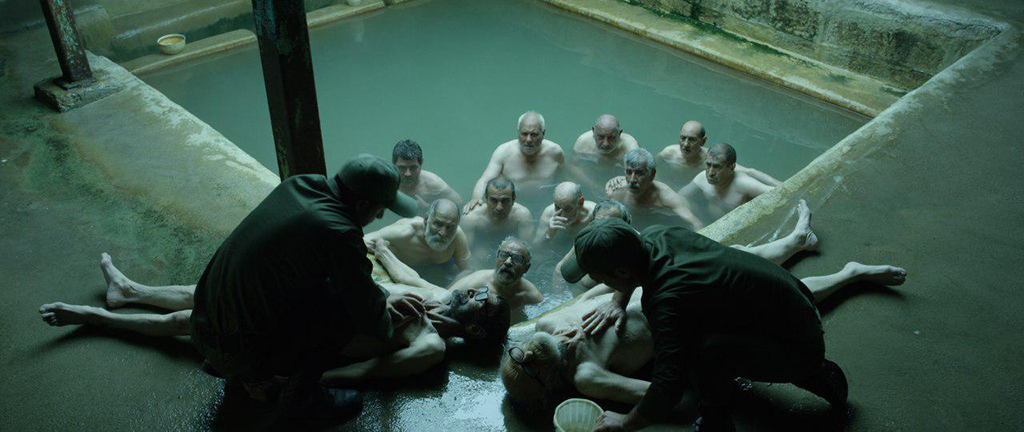
For Michel de Montaigne, learning how to die is also a way of learning how to live.2 Death is not only an inevitable end to human life but also a condition that prompts us to reflect on life itself. Martin Heidegger similarly argues that confronting oneself as a being-toward-death opens the possibility of a more authentic mode of existence.3 Reza Jamali’s Old Men Never Die (Piremard-ha Nemimirand, 2019) explores this tension between life and death through a humorous yet deeply melancholic narrative: When death is delayed, is life still life, or does it become an unbearable repetition? Or is it truly possible to learn how to live even while waiting for death? Although deeply rooted in its Iranian cultural context, the film can also be read as a broader existential reflection.
Robert Seethaler’s reflections on death offer a fitting point of entry into the film’s atmosphere. He suggests that death remains, in a sense, an invention of the living as long as it exists only in our imagination.4 The film similarly presents death not merely as a biological end, but also as a collective idea. The elderly residents of an Azerbaijani-speaking village in Iran have long been waiting for Azrael—the angel of death in Islam. Death never arrived when it was expected. As the years pass, waiting turns into impatience, and impatience into despair. As the burden of life grows heavier, the desire for death begins to seem like an easier way out. The film portrays the tragicomic consequences of this desire through the characters’ failed suicide attempts. The state’s decision to send soldiers to the village to prevent the elderly from harming themselves adds a bureaucratic and absurd layer to the narrative. The soldiers are tasked not with protecting the elderly from death, but with preventing them from killing themselves; yet this situation soon turns into a life sentence of its own. This denial, unfolding through humor and entertainment, in fact serves as a constant reminder of death.
The absence of death transforms life from a gift into a burden. Yet death’s delay does not dissolve the bonds among the villagers. Shared meals, everyday conversations, and small rituals continue throughout the film. As life is prolonged, its weight becomes increasingly palpable. As Milan Kundera writes in The Unbearable Lightness of Being (Nesnesitelná lehkost bytí, 1984), the weight of existence can make life feel more real and grounded.5 In this sense, the postponement of death increases the burden the characters carry while simultaneously making life more tangible. The film thus suggests that the absence of death can be just as weighty and decisive as death itself.

The film then introduces a second narrative thread. As news spreads that “death has forgotten this village,” terminally ill people from other places begin arriving there as well. The village is no longer inhabited solely by those waiting to die, but also by those hoping to extend their lives a little longer. On one side are elderly people longing for death; on the other are those who seek refuge in the village in order to hold on to life. The village thus becomes a place of longing for death for some, while serving as the final refuge of hope for others.
The film’s use of space constructs the idea of delayed death not only narratively but also visually. In the mountainous landscape where the story takes place, the characters are often seen in wide shots, appearing as small figures against the vastness of their surroundings. The stillness of the mountains and sky creates a striking contrast with the aging and exhaustion of the elderly characters, who have been waiting for death for years. While the human body changes over time, the landscape surrounding it remains almost motionless. This contrast takes the characters’ waiting beyond the ordinary rhythm of everyday time: life seems to continue in the village, yet time itself appears not to move forward. At the same time, the village’s relative isolation from the outside world reinforces the sense that death does not operate here as it does elsewhere. In this way, space becomes more than a backdrop to the story; it becomes a central cinematic element through which the film makes visible the delay of death, the suspension of time, and the transience of human life.
This idea recalls Jorge Luis Borges’s story The Immortal (El inmortal, 1947), which presents immortality not as a blessing but as an experience that gradually erodes the meaning of existence, since the absence of death deprives life of its defining limits.6 In the absence of death, time turns into endless repetition, and experiences lose their uniqueness, diminishing the value of life itself. In Jamali’s film, however, death does not disappear altogether—it is merely delayed. Precisely this delay fills the characters with a longing for death while simultaneously rendering life both an unbearable burden and an invaluable possibility. Whereas immortality in Borges’s story gradually empties life of meaning, the postponement of death in Old Men Never Die makes life more visible, more immediate, and more tangible. Although they differ in tone, both works ultimately pose the same philosophical question: If death disappears—or becomes unattainable—can life still retain its meaning?

Later in the film, we see one of the characters, who has been eagerly awaiting death, watering the flowers in the rooftop garden he has created, day after day. The water in his hands belongs not to death, but to life. In another scene, one of the elderly men falls in love with a woman much younger than himself. One of the film’s final scenes is a wedding that culminates in a joyful dance by the old men. These acts of life, unfolding in the midst of those waiting for death, deepen the film’s irony. Even the desire for death coexists, often without their awareness, with the small rituals that sustain life—watering a flower, falling in love, dancing at a wedding.
When death finally arrives at the end of the film, the sadness in the elderly villagers’ eyes reveals how much life means to them. The characters who longed for death come to realize the weight of what they are about to lose when they finally confront it. Jamali reminds us of the paradoxical nature of death and life: the longed-for end and the life that is about to be lost coexist at the same moment. With tragic irony, the film invites us to reconsider the fragile boundary between life and death, leaving the audience with a lingering emotional resonance.
Human beings are one with the branches, with the clouds,
Having passed through the same expanse of blue.
How can a person die
When life is so beautiful?7
- Sezai Karakoç, Leyla ile Mecnun (Istanbul: Diriliş Yayınları, 2000), my translation. ↩︎
- Michel de Montaigne, The Complete Essays of Montaigne, trans. Donald M. Frame (Stanford, CA: Stanford University Press, 1958), Book I, Chapter 20. ↩︎
- Martin Heidegger, Being and Time, trans. John Macquarrie and Edward Robinson (New York: Harper & Row, 1962), Division II, Chapter 1. ↩︎
- Robert Seethaler, Son Senfoni, trans. Regaip Minareci (Istanbul: Timaş Yayınları, 2021). ↩︎
- Milan Kundera, The Unbearable Lightness of Being, trans. Michael Henry Heim (New York: Harper & Row, 1984). ↩︎
- Jorge Luis Borges, “The Immortal,” in The Aleph and Other Stories, trans. Andrew Hurley (New York: Penguin Classics, 2004). ↩︎
- Fazıl Hüsnü Dağlarca, Aç Yazı (Istanbul: Varlık Yayınları, 1951), my translation. ↩︎

Leave a Reply