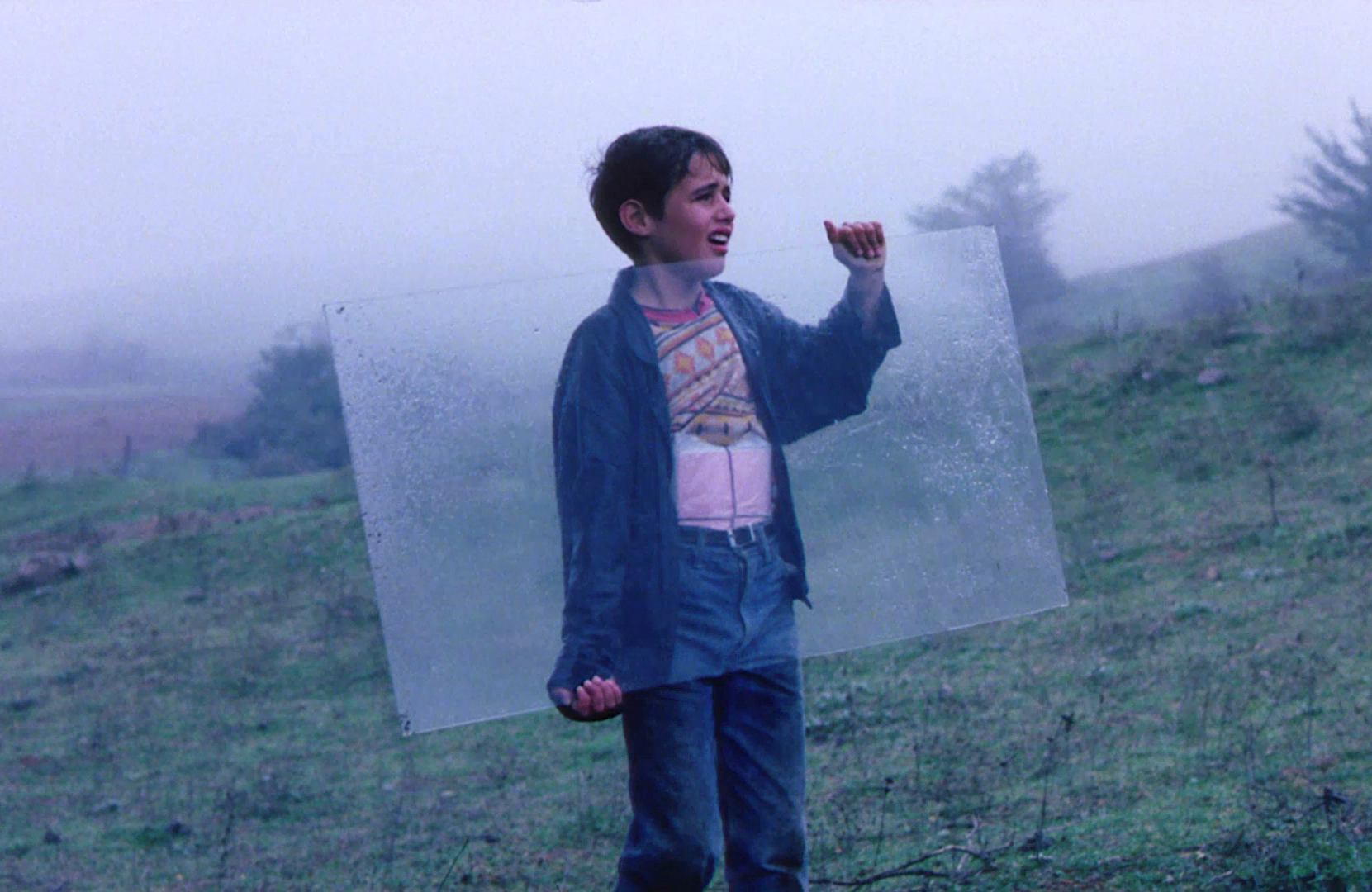
Willow and Wind (Bid o Bad, 1999) marks a subtle shift in Mohammad Ali Talebi’s filmmaking. The change in tone likely owes something to Abbas Kiarostami, who wrote the screenplay and brought his characteristic sensitivity to the natural world. Instead of the urban streets of Tehran that shaped Talebi’s earlier films, The Boot (Chakmeh, 1992) and Bag of Rice (Kise-ye Berenj, 1997), the story unfolds amid the lush subtropical landscapes of northern Iran.
The short video essay below approaches the film through three interconnected layers of meaning.
1. A Child Carrying Too Much
On the surface, Willow and Wind tells a simple story. While playing soccer, a young boy named Kouchakpour accidentally breaks a classroom window. His strict teacher gives him an ultimatum: the glass must be replaced before evening, or he will be expelled from school. Desperate to fix the damage, Kouchakpour tries to obtain a replacement pane. Instead, he encounters his family’s poverty and the indifference of those around him. As time runs out, the threat of punishment and the weight of responsibility become far greater than any child should have to bear.
2. Nature Resisting Control
The film was shot in Iran’s Gilan Province, where the region’s dense greenery, relentless wind, and heavy rain are much more than a picturesque backdrop. Kouchakpour’s greatest struggle is not with society but with nature itself. Carrying a fragile pane of glass, he struggles against powerful gusts. Every step risks disaster. The natural world is both breathtaking and unforgiving—a force that cannot be mastered.
3. Endurance Meets Transcendence
Talebi presents nature not simply as an obstacle but as a mysterious and deeply paradoxical presence. It inspires wonder as much as fear. The film is not concerned with humanity’s triumph over the natural world. Instead, it invites the viewer to see that relationship differently. The tension between the young protagonist and his environment is never fully resolved. Rather than offering victory, Willow and Wind points toward something quieter and more elusive: a mysterious, almost inexplicable reconciliation with existence itself, despite the hopelessness of the struggle.
If you found this blog valuable, please consider supporting it. Every share or small contribution helps sustain independent writing on Iranian cinema.

Leave a Reply