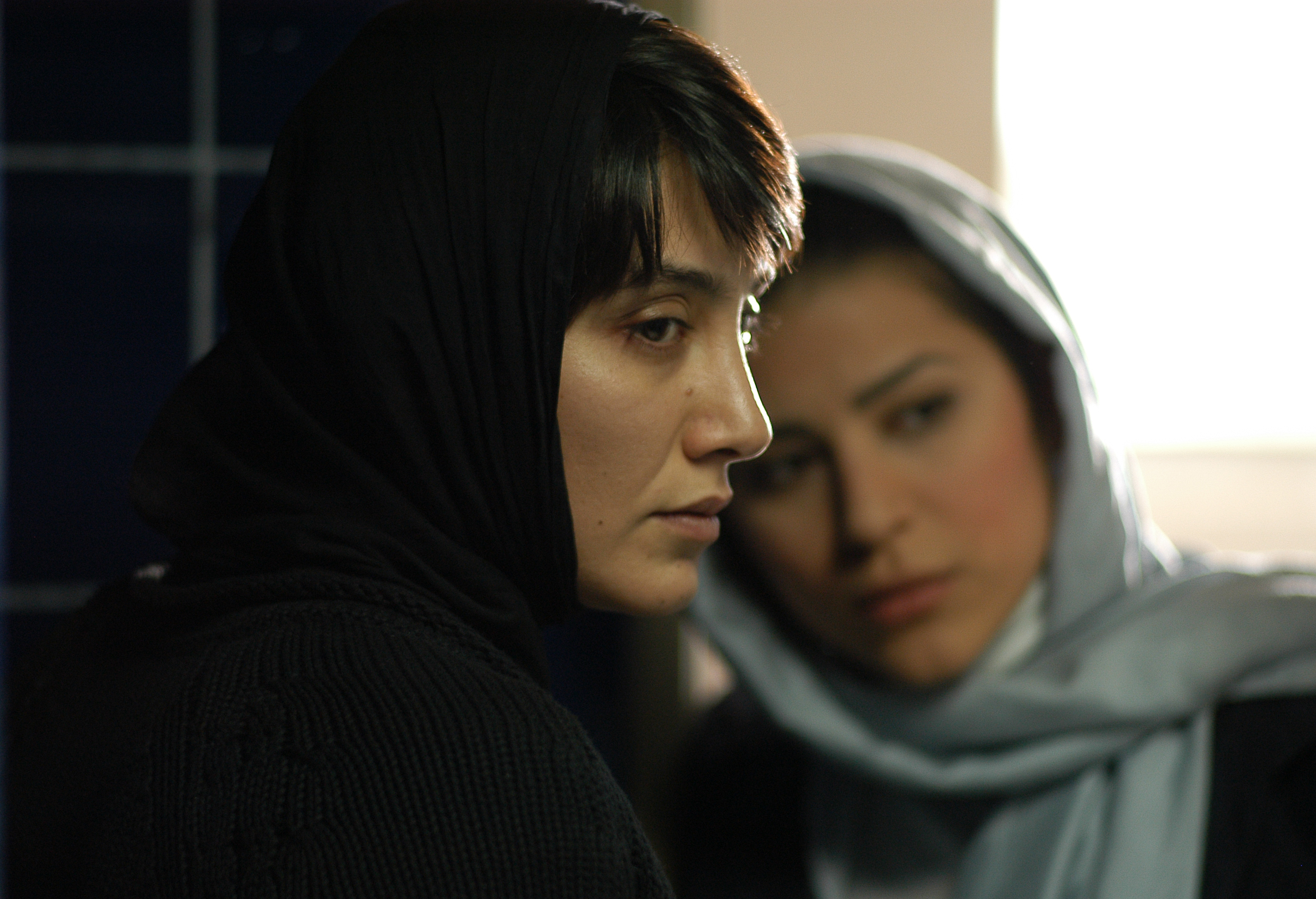
Fireworks Wednesday (Chaharshanbe-Suri, 2006) is a key film in Asghar Farhadi’s career. Compared with his more straightforward early films, Dancing in the Dust (Raqs dar Ghobar, 2003) and The Beautiful City (Shahr-e Ziba, 2004), it is here that he begins to develop the distinctive style that would later reach full maturity in A Separation (Jodai-e Nader az Simin, 2011). His finest films are built around a realism in which the story gradually unfolds as a process of uncovering the truth, undermining certainty, and shifting perspectives. Farhadi is interested not only in what happened, but also in how his characters reshape reality to fit their view of the world. He keeps non-diegetic music to a minimum, concentrates the action in a handful of locations, and follows his characters through long scenes, often built around arguments. Tension emerges both within families and among friends, as it does in About Elly (Darbare-ye Eli, 2009), and at the intersection of different social classes.
Young Roohi (Taraneh Alidoosti), the protagonist of Fireworks Wednesday, wants to save as much money as possible for her wedding. A young woman from a poor background, she takes a cleaning job through an employment agency and finds herself caught in the middle of a married couple’s conflict. Neurotic and suspicious, Mozhdeh (Hediyeh Tehrani) is convinced that her husband Morteza (Hamid Farrokhnezhad) is having an affair with their neighbor, Simin (Pantea Bahram), who owns a beauty salon. Desperate to uncover the truth, she listens through the bathroom ventilation shaft. She also uses Roohi as a source of information that might confirm her suspicions.
Farhadi films the most violent moment of the marital conflict without unnecessary pathos. From his office, Morteza sees his wife on the street and realizes that she is spying on him. Furious, he takes the elevator to the ground floor, runs outside, and violently beats her. The camera never leaves the elevator, and we watch the assault through its glass walls. We are left unsure of what we are really seeing. As the elevator and camera return upstairs, a musical motif enters the soundtrack and retrospectively casts the scene in a sadder light. The image fades to black, while we hear Mozhdeh crying. Farhadi first presents the violence with an almost documentary detachment and only then allows emotion to enter. Our sympathy for the victim emerges without any need for melodrama.
Space, meanwhile, serves more than a realistic function. It also has a psychological and social dimension. Like the characters, the viewer moves through an environment in which parts of reality are concealed or accessible only indirectly. The apartment being cleaned for the Persian New Year, Nowruz, reflects the state of the marriage. There is disorder everywhere. Furniture is covered in plastic, and the broken window caused by Morteza’s outburst remains part of the mise-en-scène. The apartment’s location on an upper floor, together with the broken intercom at the entrance, also suggests how inaccessible this world is to a young woman from a lower social class.
Morteza beats his wife partly because her spying makes him look bad in front of his colleagues. Yet the film refuses to tell us exactly how much his need to defend his honor is culturally conditioned and how much stems from his individual psychology. This ambiguity is central to Farhadi’s work. His characters cannot be separated from the environments in which they live, but neither can they simply be reduced to those environments. He continually examines reality from different angles and touches on a wide range of social issues. When Mozhdeh, for instance, complains about the school that scarred her son by teaching him about hell, her words can be read as a criticism of the Iranian education system shaped by religious influence. At the same time, the film convincingly suggests that the child’s real “hell” is created above all by his own parents, not by the state.

Farhadi also addresses censorship, but indirectly. At the beginning of the film, Roohi tries on a wedding dress. She wears it over her everyday clothes, however, and keeps her hair covered with a scarf. The situation is comic, but it also arises from the rules imposed by Iranian state censorship on the depiction of women. Farhadi follows those rules. Yet by adhering to them so precisely, he draws attention to their absurdity and makes mandatory hijab a visible subject in its own right. Later, Morteza and his colleagues are preparing an advertising clip. They discuss a problematic shot of an actress whose scarf is not positioned “correctly” and whose hair is showing.
Farhadi finds a way to address censorship without making himself its target. A similar strategy shapes Roohi’s way of communicating. As the story progresses, she learns what she “should” say in order to avoid conflict. She is more than ten years younger than Mozhdeh and Morteza and is still waiting to get married herself. Next to the bickering couple, her relationship with her fiancé seems happy, even though it contains subtle signs of tension. Roohi brings an innocent perspective to the story, but Farhadi avoids idealizing her. Her mischievous looks and bursts of youthful laughter convey her spontaneity. At the same time, the film shows how easily that innocence can be disrupted by reality.
Moving between the married couple and Simin, Roohi pieces together fragments of information and begins to suspect that Morteza really is cheating on his wife. There seems to be no practical reason for Roohi to hide the truth. Yet she gradually resorts to small, spontaneous lies and tries to keep Mozhdeh from discovering the affair. Why? Roohi wants to avoid conflict. She does not want to become involved in the breakup of someone else’s marriage. She wants to preserve a world without conflict, a world in which things can return to an appearance of order. But this ideal world is built on lies. Just as censorship alters the representation of reality, Roohi learns that sometimes it is easier to leave certain things unsaid. The tension between a constructed ideal—or myth—and reality can be seen as one of the film’s central themes.
The Persian title, Chaharshanbe-Suri (literally “Scarlet Wednesday”), refers to the Iranian Festival of Fire, whose roots lie in Zoroastrianism, the religion that dominated Iran before its Islamization. The last Wednesday before Nowruz, which marks the beginning of spring, serves as a richly ambiguous motif in the film. Fireworks and firecrackers are one of the few sources of joy for the couple’s unhappy son. At the same time, they create an atmosphere of chaos. The explosions that constantly punctuate the film sound like gunshots, becoming an aural counterpart to the couple’s arguments. At the height of the celebration, people light bonfires in the streets and jump over them. During this cleansing ritual, Iranians traditionally recite a plea: “Give me your red glow and take away my sickly pallor.”
The ritual is meant to transform and heal the community. In Farhadi’s film, however, the burning fires evoke images of hell rather than purification. There is no springtime rebirth, and the marital conflict remains unresolved. Roohi leaves to begin her own marriage carrying an unwanted lesson from someone else’s relationship—and the knowledge that the idea of a peaceful life may depend on what we are willing not to see and not to say.
Iran Zamin Cinema is an independent, ad-free publication dedicated to Iranian cinema. Support the project on Buy Me a Coffee and help keep thoughtful essays and film analysis freely available.


Leave a Reply