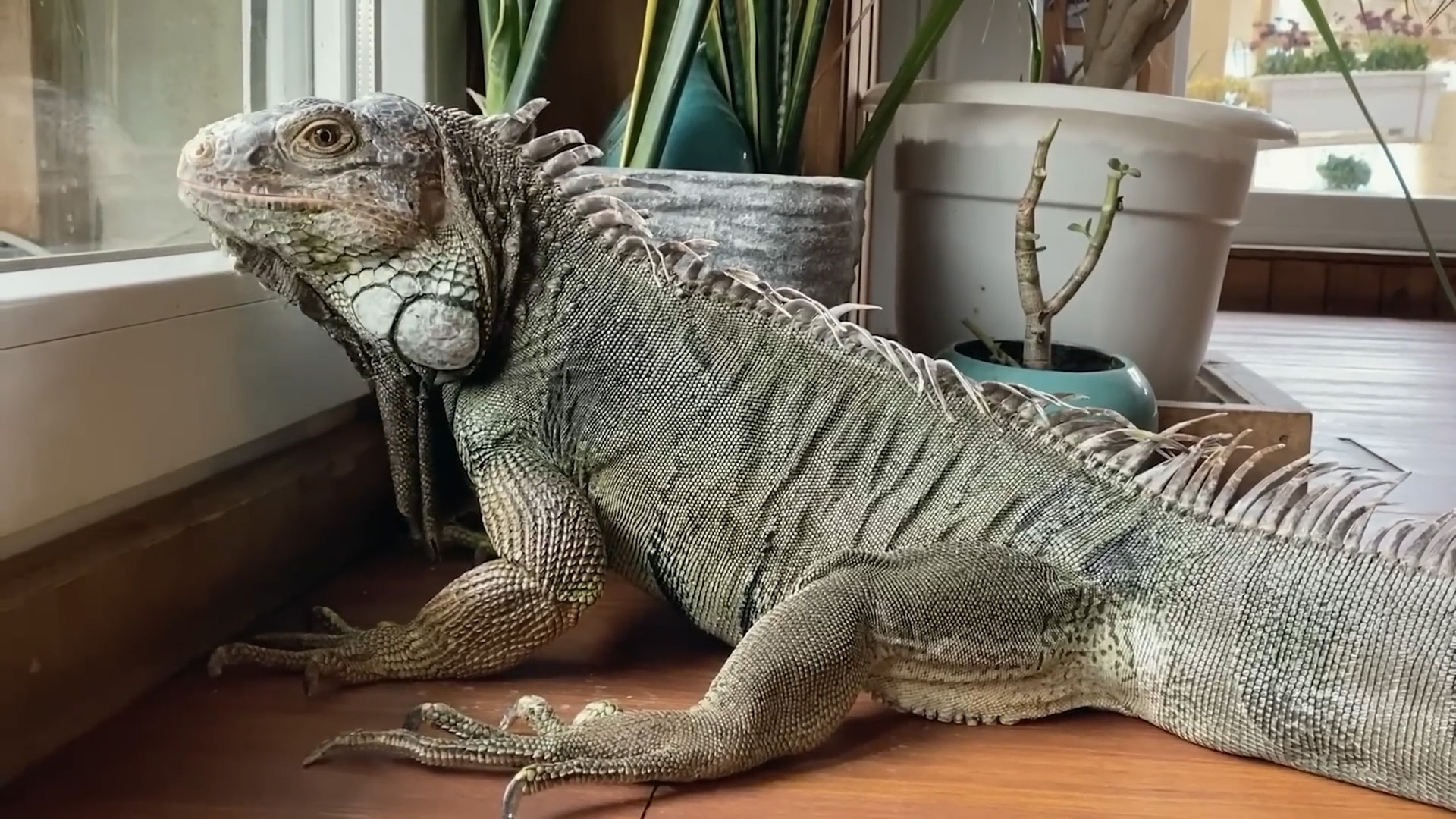
An iguana slowly makes his way through a spacious apartment in Tehran. He looks through the closed balcony doors. Outside, a crow sits against the backdrop of the snow-capped Alborz Mountains. A pigeon’s egg rests on the balcony floor. The iguana watches it intently, until two pigeons approach and instinctively shield the egg with their bodies. In just a handful of simple shots, the opening of Jafar Panahi’s short documentary Life (Zendegi, 2021) introduces the film’s central concerns: the threat of death, care for others, and the enduring drive to preserve life.
Life was made during the COVID-19 pandemic as part of the anthology The Year of the Everlasting Storm (2021), which brings together films by directors from five countries. Alongside Panahi, the project features Apichatpong Weerasethakul, Malik Vitthal, Anthony Chen, Laura Poitras, Dominga Sotomayor, and David Lowery. Film critic Richard Brody considered Panahi’s contribution the best part of the anthology. He wrote that “with a style somewhere between casual home movies and thoughtful compositions, Panahi sublimates the fine points of immediate experience into grand cinematic symbols.”1
As in This Is Not a Film (In film nist, 2011), Panahi shoots Life inside his Tehran apartment. He experiences the pandemic while already living in political isolation, banned by the Iranian authorities from making films. In his earlier clandestine works, Panahi responded to state repression with ingenuity and persistence. Life confronts the threat of the coronavirus with a quiet confidence. Rather than dwelling on the fear of death, it searches for ways to restore intimacy—not only between people, but also between human and nonhuman beings.
Panahi’s mother arrives wearing a white protective suit and carrying disinfectant spray. The film is shot by Panahi and his wife, Tahereh, who document the visit on their smartphones—a method already seen in the documentary Hidden (2020). It is the first time Panahi’s mother has seen her son and daughter-in-law in person since the lockdown began. She jokes that he had been leaving groceries at her door and disappearing before she could even say hello. Beneath the humor, however, lies genuine fear. She worries that she might die of COVID-19 before she ever sees her grandchildren again. Lacking internet access at home, she asks to speak with her granddaughter Solmaz, who lives in Paris.
During their video call, the grandmother begins singing a lullaby she used to sing to Solmaz as a child. Through the song, she tries to recover the closeness that distance has interrupted:
My daughter, my sweet daughter,
new sign of life in our household.
My violet of Arbedil,
my honey of Sabalan.

The longing for mutual understanding lies at the emotional core of the film. Panahi’s own identity also plays an important role. An ethnic Iranian Azerbaijani, he naturally weaves two languages into the film. Panahi, his wife, and their daughter mostly speak Persian, while his mother prefers Azerbaijani. Their constant shifting between the two languages never creates distance. Instead, it suggests that genuine intimacy depends less on linguistic unity than on the bonds of family.
The film’s true barriers arise elsewhere. They emerge from existential experiences of otherness, fear, and mortality. These themes find their clearest expression in the relationship between Panahi’s mother and the family iguana, Iggy, a fully accepted member of the household. She, however, is terrified of him. Like the coronavirus itself, the iguana embodies something unfamiliar and potentially threatening.
Iggy is more than an eccentric pet or a mere gimmick. He serves as the film’s central catalyst, connecting its many themes. His slow movements mirror the grandmother’s age and physical frailty. Like her, he depends on the care of those around him, a fact underscored when Tahereh feeds him. His patient observation of the world also reflects Panahi’s own filmmaking, which is defined by the same attentive way of looking. Just as the grandmother rejects the iguana as an unwelcome presence in the home, Panahi himself remains an unwanted figure in the Islamic Republic, excluded from the country’s official cultural sphere.
The iguana’s presence challenges deeply rooted prejudice. He represents radical otherness, yet he cannot simply be ignored or pushed aside. Accepting him ultimately becomes an act of accepting difference itself. Animals also play a key symbolic role in Panahi’s It Was Just an Accident (Yek tasadof-e sadeh, 2025)—different characters’ reactions to harmless dogs reveal whether they are willing to follow their conscience. In Life, transformation begins only when the grandmother finally sets aside the stick that has been threatening Iggy. Only then does the film unveil its quiet miracle of life—the hatching of the pigeon chick— and trust can be restored within the household.
Life reminds us that Panahi should not be understood solely as a political filmmaker. Politics remains an essential part of this film, but it is not its primary concern. Instead, Life unfolds as a philosophical meditation on otherness, mortality, and the possibility of human connection. In this respect, it recalls the cinema of Abbas Kiarostami, particularly And Life Goes On (Zendegi va digar hich, 1992), Taste of Cherry (Ta’m-e gilas, 1997), and The Wind Will Carry Us (Bad ma ra khahad bord, 1999). Kiarostami repeatedly raised questions about death without succumbing to despair or pessimism. Rather, the awareness of mortality deepened his characters’ sensitivity to the beauty of the world.
Viewed in light of Panahi’s own circumstances, Life becomes even more affecting. He does not speak about hope from a position of safety or through abstract humanist ideals. His faith in human connection grows out of years of political isolation and an enduring state of internal exile. That experience gives the film’s conclusion its extraordinary emotional weight. Hope is not presented as a comforting slogan but as an existential necessity. It is a fragile yet resilient force, born from a willingness to listen and embrace what first appears unfamiliar.
Iran Zamin Cinema is an independent, ad-free publication dedicated to Iranian cinema. Support the project on Buy Me a Coffee and help keep thoughtful essays and film analysis freely available.


Leave a Reply