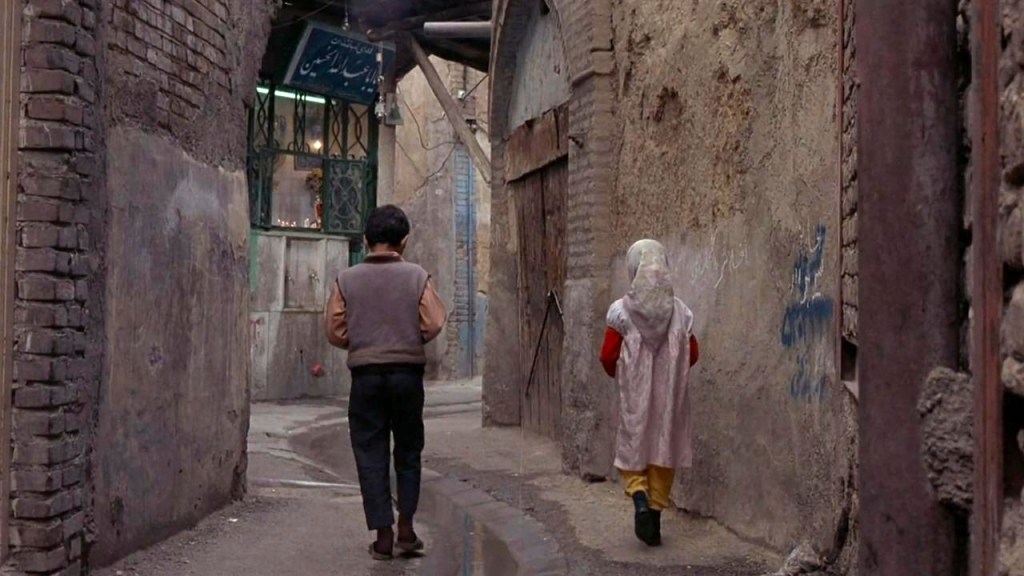
Paul Schrader’s influential book Transcendental Style in Film: Ozu, Bresson, Dreyer remains one of the key texts on how cinema can function as an expression of the transcendent. Because the book was first published in 1972, Schrader had no opportunity to consider the major Iranian films that would later seem to fit naturally within his framework—works that only began to emerge in the decades that followed. Still, I have often wondered how Schrader might have approached the poetic tradition of post-revolutionary Iranian cinema.
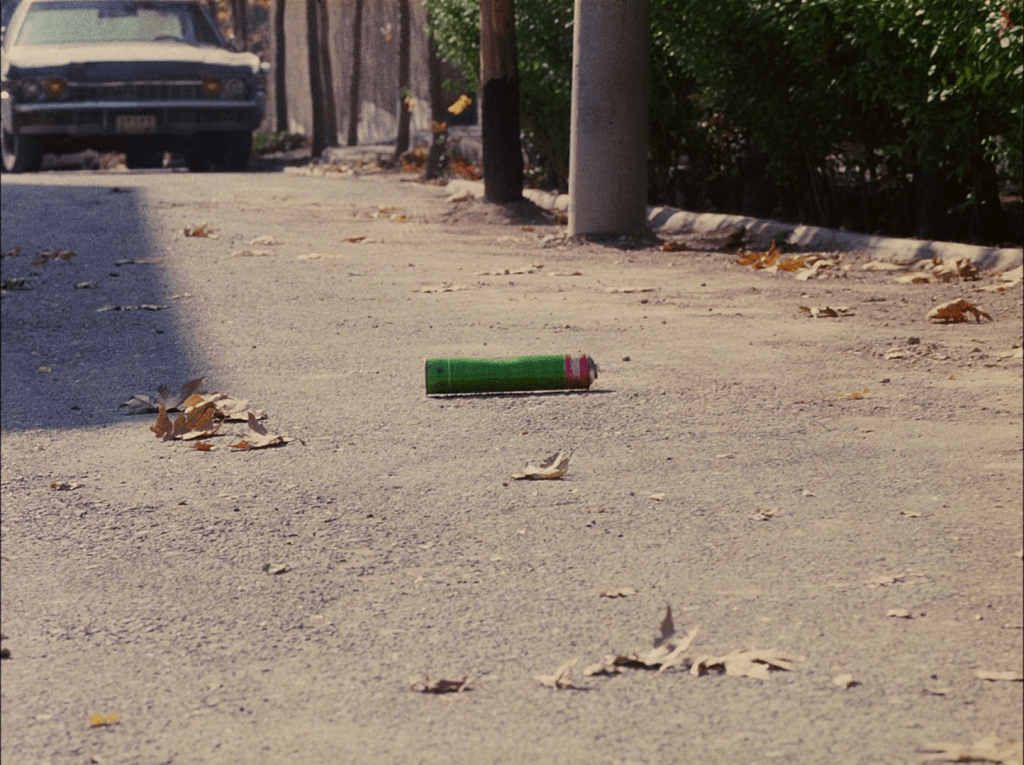
He offered a partial—though to me not entirely satisfying—answer in the new introduction to the book’s updated 2018 edition, where he reflects on how cinema has changed since the 1970s. Among Iranian films, he mentions Close-up (Nema-ye nazdik, 1990) by Abbas Kiarostami, placing it within the context of slow cinema. In one scene, a minor character kicks an empty aerosol can, and the camera lingers in a long take as the object rolls down the street until it finally comes to rest. By dwelling on an apparently irrelevant action, the film creates its own deliberate rhythm. For Schrader, however, this gesture ultimately remains humanist rather than spiritual.1 In other words, in Kiarostami’s cinema, transcendence does not need to be sought beyond lived reality; it can be experienced within everyday life itself—even in something as simple as the taste of cherries.
In my view, however, the transcendent dimension of Iranian cinema can be explored further through the films of Majid Majidi. Kiarostami and Majidi represent two distinct approaches to transcendence, and even their film titles suggest as much. Kiarostami’s titles remain grounded in ordinary reality: And Life Goes On (Zendegi va digar hich, 1992), Through the Olive Trees (Zire darakhtan-e zeytun, 1994), or Taste of Cherry (Ta’m-e gilas, 1997). His films locate the sacred within everyday experience.
Majidi’s titles, by contrast, point toward an ideal spiritual realm that seems to exist beyond the ordinary world: God Will Come (Khoda miad, 1995), Children of Heaven (Bacheha-ye aseman, 1997), The Color of Paradise (Rang-e khoda, 1999), Beyond the Clouds (2017), or Sun Children (Khorshid, 2020). Where Kiarostami discovers transcendence in the texture of daily life, Majidi gestures toward a world beyond it.
Everyday Life and the Sacred: Children of Heaven through Paul Schrader’s Theory
Children of Heaven is not a pure example of transcendental style as Schrader originally defined it. In his formulation, transcendental style suppresses character psychology and emotion, deliberately creates boredom, and often minimizes the use of music. Majidi does almost the opposite: he emphasizes the psychological depth of his child protagonists, tells simple yet emotionally gripping stories, and uses music actively to intensify feeling. And yet, despite these differences, I would argue that his films still achieve the central goal of transcendental style: creating tension between everyday life and something higher that cannot be directly shown.
For Schrader, films operating in a transcendental mode proceed through three stages: the everyday, disparity, and stasis. The first stage presents ordinary life stripped of drama, catharsis, and overt meaning—a world of routine, banality, and emotional restraint. On its own, everyday reality contains nothing transcendent, which is why it must be followed by two further movements. The second stage, disparity, occurs when a character introduces an unexpected emotion or gesture into this routine environment. At that point, the viewer begins to sense that behind the cold material surface of the world there may be something else—something that does not originate within material reality itself. Disparity culminates in what Schrader calls the decisive action, which then gives way to the final stage: stasis, a closing image marked by stillness, repose, and the appearance of the transcendent.
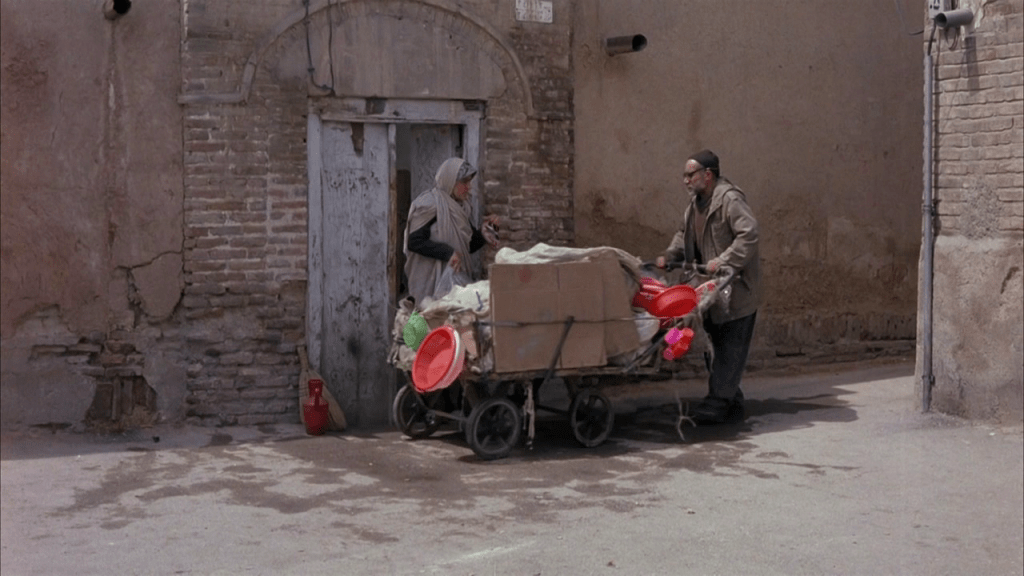
Like many Iranian films centered on children, Children of Heaven focuses on the hardships of people from the lower social strata. Its everyday world clearly reflects the neorealist impulse of socially conscious cinema. The family’s difficult economic situation is condensed into the film’s central narrative problem: young Ali loses his sister’s shoes while returning from the shoemaker. What follows—the search for the missing shoes—turns an ordinary object into something profoundly valuable, echoing the logic of Bicycle Thieves (1948) by Vittorio De Sica. The significance of an everyday object for the poor is a recurring theme in Iranian children’s cinema. A striking parallel appears in The Boot (Chakmeh, 1993) by Mohammad Ali Talebi, which similarly revolves around the loss of a girl’s shoe. Working with limited budgets, many Iranian filmmakers build narratives around modest incidents, using them both dramatically and as vehicles for a social critique.
Majidi’s narrative economy is also reinforced through repetition and variation. One recurring figure is the scrap collector who inadvertently causes the shoes to disappear at the beginning of the film. As the story unfolds, he returns again and again, becoming part of the texture of everyday life in the impoverished neighborhood. A similar ritual structure shapes other motifs: the children repeatedly leave for school and return; they repeatedly meet in the same narrow alley to secretly exchange sneakers so they can each attend classes.
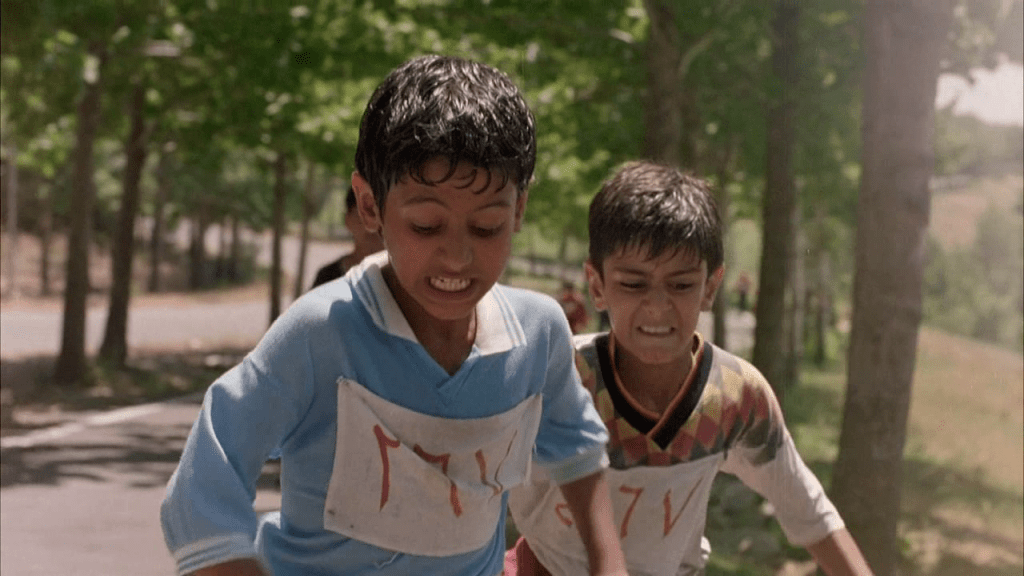
The second stage of transcendental style—disparity—is most clearly visible in the decisive action, here embodied in the boys’ race. Because third prize is a new pair of sneakers, Ali enters the race with a very specific goal. What emerges is a tension between social marginalization and the extraordinary intensity of a child’s determination to solve a seemingly small but emotionally overwhelming problem.
At the same time, Majidi’s storytelling differs sharply from that of Robert Bresson, Yasujiro Ozu, or Kiarostami because it remains deeply tied to emotion, which softens the distinction between the everyday and disparity. In Schrader’s model, transcendental cinema avoids realism, psychologism, and romanticism, since these are understood as emotional or rational constructions imposed on reality.2 Children of Heaven, by contrast, gathers a broad emotional range: Ali’s fear is immediate and vivid, the family’s suffering is palpable, and moments of childhood joy are deeply affecting. This emotional expressiveness undermines the deliberate neutrality that Schrader associates with the everyday stage; in his framework, emotion should emerge only later, in disparity.
Still, even if the dialectic between the everyday and disparity is less sharply defined here, the third stage—stasis—is powerfully present. Ali wins the race, but victory only deepens his pain: he needed third place, not first, because only third prize would have given him the shoes he hoped to bring home. In the final scene, he returns exhausted and disappointed, sits in the courtyard, and lowers his blistered feet into a small pool filled with fish.
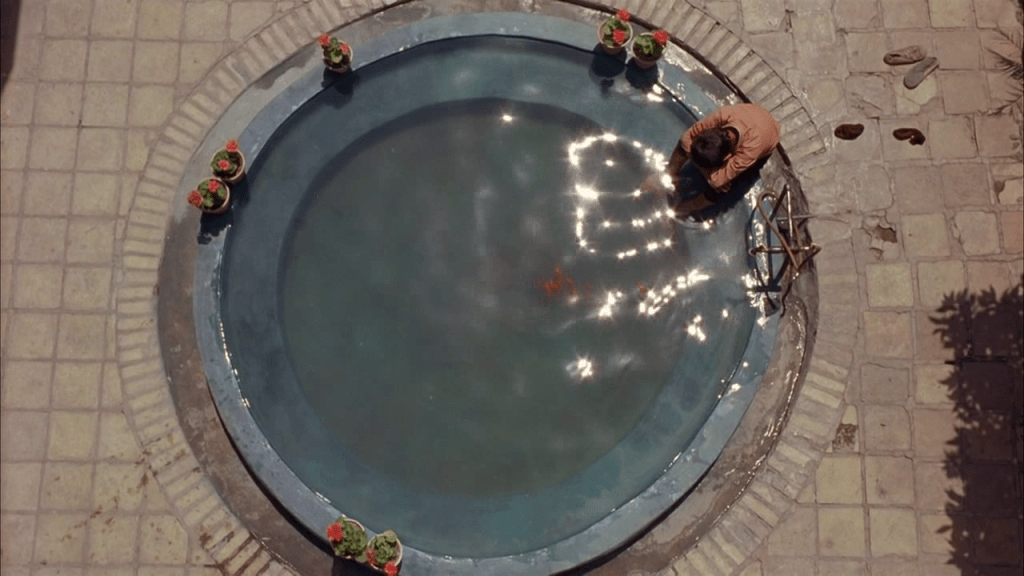
The camera initially observes the moment from above, almost from a divine perspective. Throughout the film, Ali has had no real source of comfort; aside from his sister, he has no one to whom he can confess what happened. In this final stasis, that condition changes. In close-up, fish swim toward his wounded feet and begin gently kissing them, as if offering a form of healing. Ali’s exhausting effort in the race has not resolved the family’s hardship, but transcendence appears only after this decisive action. Redemption arrives neither according to the boy’s plan nor as the result of human will. It comes from elsewhere—as something wholly other. In this sense, Majidi’s transcendental style can be understood as moving beyond neorealism without abandoning its social-critical foundation.

Memorable moments of stasis recur throughout Majidi’s work, often with closely related visual elements. Water repeatedly returns in his endings: in The Willow Tree (Bid-e majnoon, 2005), again as courtyard water; in The Father (Pedar, 1996), reconciliation takes place at a desert oasis; in The Color of Paradise, a child touches God at the edge of the Caspian Sea; and both Baran (2001) and Beyond the Clouds conclude with redemptive rainfall. Another recurring element is animal life, from birds and camels to an insect. Nature in Majidi’s moments of stasis carries a symbolic charge of the sacred. The divine order reflected in earthly creation becomes especially central in The Color of Paradise, where a blind child reads the surfaces of natural objects as if they were written in Braille.
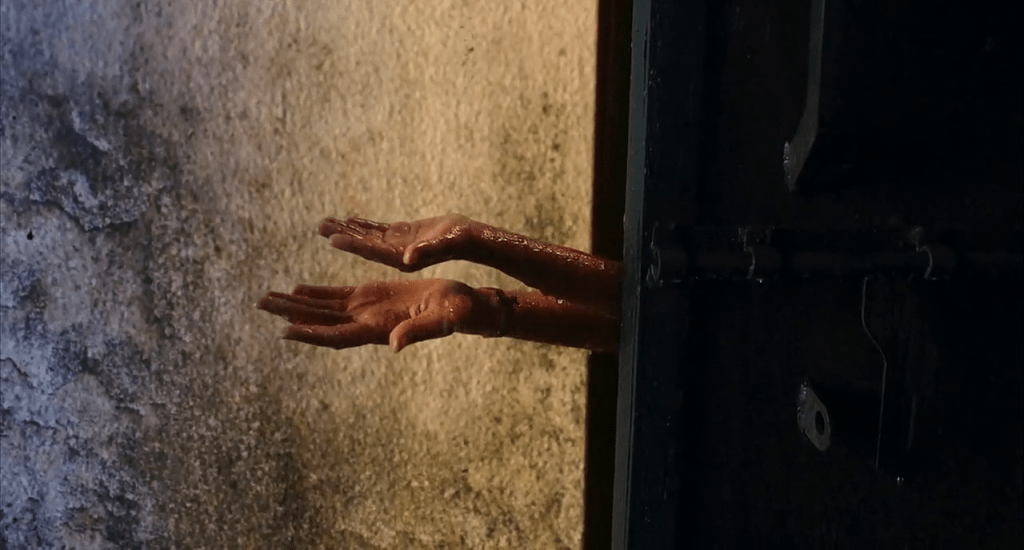
What is especially striking, however, is that Children of Heaven does not end entirely in stasis. During the closing credits, as the music slowly fades, the sound design brings back the scrap collector introduced earlier in the film—the same figure whose accidental action triggered the loss of the shoes. Throughout the narrative, he functioned as a marker of ordinary daily life. Why return to him at the very end?
From the perspective of transcendental style, the answer may be that everyday life is not something hostile that must be canceled out by later stages. For Schrader, stasis opens a “new” world in which the spiritual and the physical coexist—still unresolved, still held in tension, but now revealed as expressions of the transcendent.3 The viewer, having passed through stasis, is returned to everyday life transformed. Through the reappearance of the scrap collector, ordinary existence comes back into view, now potentially charged with the presence of what had seemed wholly other. The Marxist-materialist frame of neorealist observation gives way to a transcendent perspective—one in which the ordinary is not abandoned, but quietly illuminated.
Shia Symbolism in Majid Majidi’s Cinematic Vision
Why does Majidi rely so heavily on emotion? The answer lies in Iran’s cultural and religious traditions. Just as Robert Bresson was shaped by Catholicism and Andrei Tarkovsky by Russian religious thought, Majidi remains deeply rooted in his own spiritual inheritance. In her book Shi’i Islam in Iranian Cinema (2011), Nacim Pak-Shiraz reads his films through two intertwined traditions. The first is Shia Islam, which occupies a minority position globally compared with Sunni Islam but is overwhelmingly dominant in Iran. The second is Sufism, whose imagery and sensibility became deeply embedded in Persian poetry. Although Pak-Shiraz focuses mainly on The Color of Paradise, Baran, and The Willow Tree, the same traditions can also be traced in Children of Heaven.
Majidi draws a clear parallel between his child protagonists and central figures from Islamic history. In one scene, young Ali is placed in visual juxtaposition with a religious image depicting Ali ibn Abi Talib, cousin and son-in-law of Muhammad. While Sunni Islam recognizes the authority of elected caliphs as Muhammad’s successors, Shia tradition follows the line of Imams. Ali is regarded as the first legitimate successor to the Prophet—the first Imam. The juxtaposition between the image and the boy’s name invites the viewer to see the child Ali as carrying an echo of that sacred lineage.
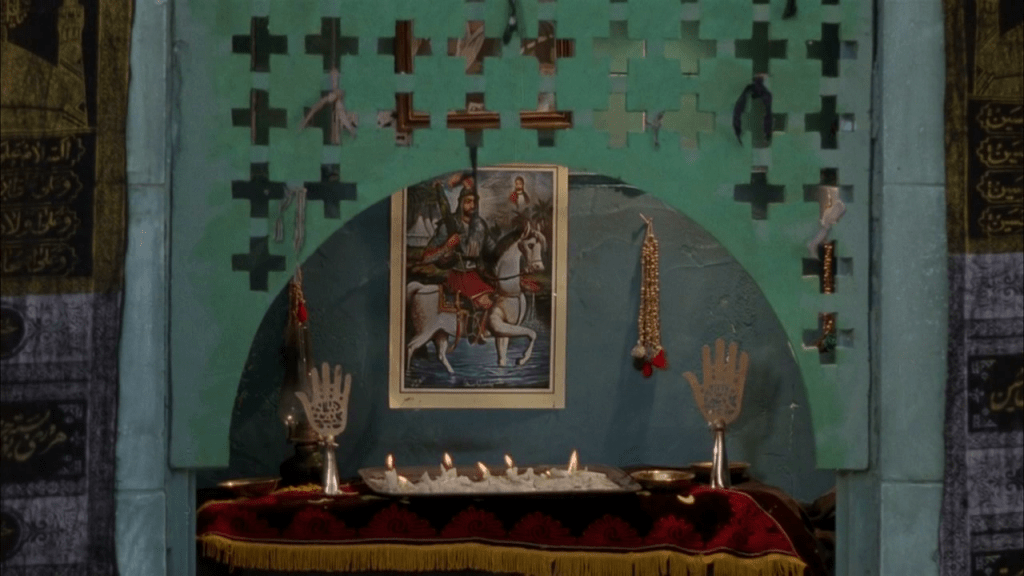
A similar resonance appears in the name of his younger sister Zahra, which recalls Fatimah—often invoked as Fatimah al-Zahra—the Prophet’s daughter and the wife of Imam Ali. In this sense, the children are “divine” not only metaphorically, but because they mirror foundational figures from Islamic memory.
Majidi does not stop there. Husayn ibn Ali, grandson of Muhammad and son of Fatimah and Ali, occupies a central place in Shia devotion above all as a martyr, killed by Sunni forces in the Battle of Karbala. His death is commemorated each year in Iran during Ashura, mourning rituals marked by public grief and, in some contexts, acts of physical self-mortification. These ceremonies reveal the intensely affective and ecstatic dimension of Shia piety.
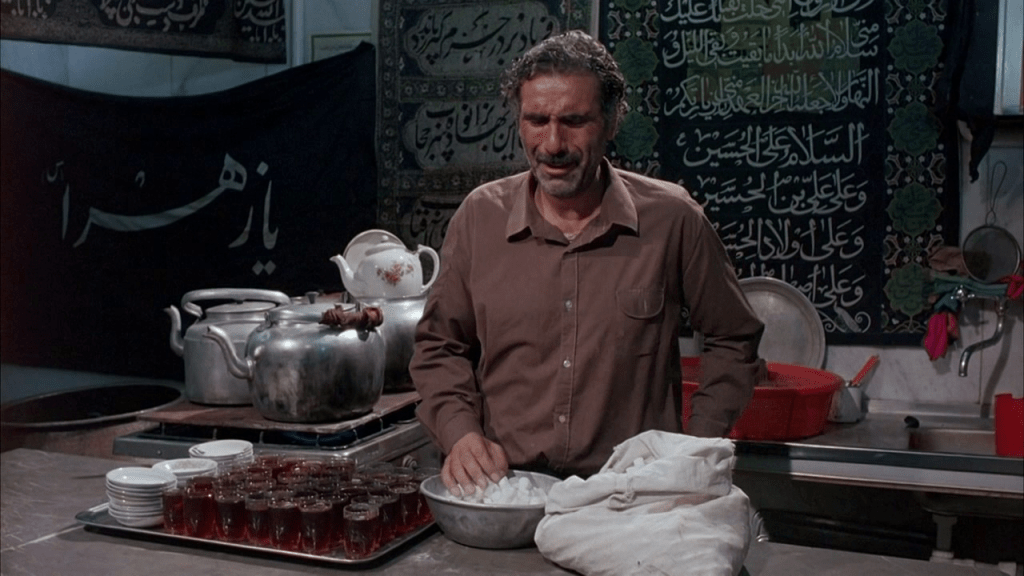
That tradition surfaces directly in the mosque scene depicting Fatimiyya mourning rituals for Fatimah, where the father of the two children begins to cry during a religious ceremony. His tears are not merely personal; they express identification both with Fatimah’s sorrow and with Husayn’s suffering. In that moment, the hardship of an impoverished family merges with the remembered pain of Shia martyrdom. Social suffering and sacred history become inseparable.
Love, Suffering, and Sufism in Iranian Cinema
Another important dimension is the Sufi tradition, which Nacim Pak-Shiraz also identifies in Majidi’s work. At the center of Sufi thought lies love for the Absolute. Through love, the seeker becomes capable of enduring every pain that God allows as a test—pain that purifies the soul. The mystic seeks to approach the ineffable not through reason or philosophy, but through the heart, because neither intellect nor conceptual thought can fully reveal ultimate reality.
This spiritual path is often described through four core principles: intuition (a spiritual sense that perceives what reason cannot), inner light (through which the soul participates in the divine), self-transcendence (the stripping away of selfishness and sensual attachment), and love.4 It is this last principle that makes Sufism especially resonant with Christian mystical traditions, while also placing it in tension with stricter orthodox interpretations of Islam. Classical Islamic theology often resisted the idea of love as a reciprocal relationship between human beings and God, since love implies a kind of proportionality between two beings—a notion many theologians regarded as an unacceptable anthropomorphism.
In Children of Heaven, the last two Sufi principles—self-transcendence and love—are especially visible. At first, Ali’s motivation for finding the lost shoes is selfish: he is simply afraid of being punished by his father. Because of that fear, he forces his sister to wear his oversized sneakers, humiliating her in the process. Gradually, however, his motivation changes. Self-preservation gives way to empathy, and he begins to internalize not only his sister’s discomfort but also the quiet suffering of his impoverished parents.
His determination to obtain new shoes becomes rooted less in fear than in compassion. What begins as a practical problem becomes an ethical transformation: the child assumes responsibility because he has discovered compassion and love within himself.
This is why the final race can be read as a kind of martyr-like trial. Ali succeeds only because he has shed the veil of selfishness. In the final stretch of the race, the film shifts into slow motion. On one level, this prolongs the suspense and allows the viewer to register each physical movement in detail. On another, the slowed pace evokes something closer to mystical ecstasy: attention narrows entirely onto Ali’s suffering, but suffering that no longer arises merely from material deprivation—it now emerges from love.
That helps explain why the race functions as disparity and decisive action within a transcendental framework: in the middle of a realistic social world, the child suddenly bears witness to an inner spiritual intensity.
Is Children of Heaven a Film of Transcendental Style?
In Majidi’s cinema, transcendental style operates in dialogue with both Shia Islam and Sufi tradition. The spiritual resonance of Children of Heaven is not produced solely through formal means of the kind described by Schrader, but also through the repeated activation of religious motifs and symbolic parallels. Because Majidi fills everyday life with strong emotions—fear, sorrow, tenderness, joy—he does not treat ordinary reality as a cold, emptied surface. As a result, the boundary between the everyday and disparity often becomes blurred. The relationship between these two stages does not function as sharply as Schrader’s model would predict.
Yet what the film loses in formal purity, it gains through religious depth. Its emotional force can be read through the ecstatic register of Shia devotion and the Sufi understanding of suffering transformed by love. Emotion here is not a deviation from transcendence; it becomes one of its pathways. That is why the final moment of stasis is so powerful. The viewer is prepared to receive it not simply as a poetic ending, but as an encounter with transcendence itself—something that arrives quietly, after suffering, from beyond the visible world.
If you enjoyed this analysis and explanation, please consider supporting my blog—either by making a donation on Buy Me a Coffee or by sharing the article with others. Your support helps me continue creating meaningful content. Thank you!

- Paul Schrader, Transcendental Style in Film: Ozu, Bresson, Dreyer (Oakland: University of California Press, 2018), 18. ↩︎
- Paul Schrader, Transcendental Style in Film: Ozu, Bresson, Dreyer (Oakland: University of California Press, 2018), 42. ↩︎
- Paul Schrader, Transcendental Style in Film: Ozu, Bresson, Dreyer (Oakland: University of California Press, 2018), 108. ↩︎
- Nacim Pak-Shiraz, Shi’i Islam in Iranian Cinema: Religion and Spirituality in Film (London: I.B. Tauris, 2011), 97–98. ↩︎

 Iran Zamin Cinema
Leave a comment