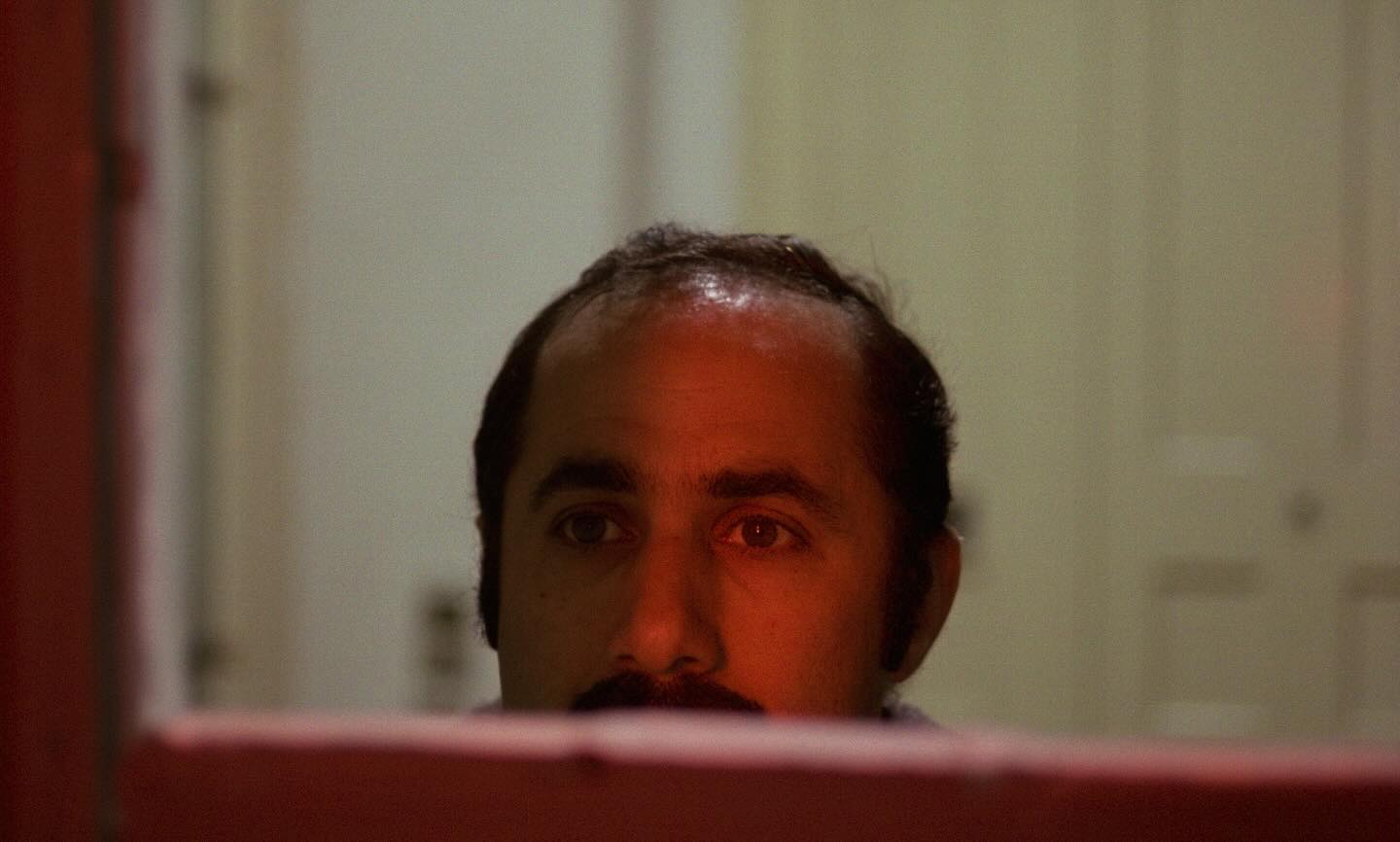
Iranian director Sohrab Shahid Saless made Far from Home (Dar Ghorbat / In der Fremde, 1975) at a turning point in his life. It was a period when he was leaving Iran and relocating to Berlin, where he would go on to live and work. It is therefore striking that the central character in his film about the experience of being a foreigner is not Iranian but a Turkish guest worker named Husseyin, played, however, by Iranian actor and director Parviz Sayyad. Husseyin lives in an old, dimly lit shared apartment with other Turkish immigrants. Every day, he commutes to a factory where he operates a press. Over and over again. Repetition becomes the film’s central narrative principle in its portrayal of the dehumanization of a man reduced to a source of labor.
Far from Home remained inaccessible for a long time. Recently, however, it was digitally restored and subsequently screened by Arbelos at several venues across the United States. Today, the restored version of this remarkable film from the Iranian New Wave is available on the streaming platforms Kanopy and Eye Film.
In Shahid Saless’s film, Husseyin’s sense of displacement is not merely a consequence of migration, but also of an environment that prevents him from making a new home for himself. The director conveys this theme through simple yet clear visual devices. The character repeatedly gets lost in the depths of urban space: in streets, subway stations, and the factory hall. The space opens up and expands before him, yet offers no possibility of escape. Berlin’s vastness here is not an expression of freedom but, on the contrary, of the oppressive weight of an environment that surrounds and engulfs the protagonist. The gloomy autumn weather and muted colors complete the picture of a world in which human individuality is dying out. One of the director’s responses to this oppressive atmosphere is a dry, bitterly absurd humor of the kind found in Aki Kaurismäki’s films. As in the work of the Finnish director, the comedy arises from the discrepancy between the protagonist’s emotional needs and the indifference of those around him. Humor here is not a means of relieving social tension, but rather a way of exposing the absurdity and cruelty of everyday existence.
The film can be seen as a lesser-known example of the New German Cinema (Neuer Deutscher Film) of the 1960s and 1970s. The movement defined itself in opposition to the commercial, formulaic productions of West German cinema. Its filmmakers sought to create more formally experimental and socially engaged work that would reflect the transformations taking place in German society. A significant part of this effort involved coming to terms with the Nazi past and searching for new forms of auteur cinema. In this respect, Far from Home has particular affinities with the work of Rainer Werner Fassbinder. In Ali: Fear Eats the Soul (Angst essen Seele auf, 1974), Fassbinder uses the romantic relationship between an older German widow and a young Moroccan guest worker to expose the racism and social prejudices of postwar Germany.

It would nevertheless be reductive to view Far from Home solely through the lens of New German Cinema. Shahid Saless also develops themes and approaches that he had already explored in his Iranian films A Simple Event (Yek ettefaq-e sade, 1974) and Still Life (Tabi‘at-e bijan, 1974). The latter is characterized by the tension between a solitary individual, whose life has been consumed by everyday routine and work, and a social system that, although remaining in the background, fundamentally shapes his fate. Shahid Saless’s Marxist-influenced social critique responded to the conditions of Iran at the time. The country was undergoing rapid modernization, which was simultaneously deepening the divisions between social classes. At the same time, by suppressing dramatic events and emphasizing the everyday, the director sought to liberate cinema from literature and distinguish his work from those films of the Iranian New Wave that drew on contemporary Persian prose. With his move to West Germany and the making of Far from Home, the political and geographical context of Shahid Saless’s work changed. The fundamental problem at the heart of his films, however, remained the same: a person whose everyday existence is subordinated to the social system loses the ability to make decisions about his own life.
Husseyin repeatedly tries to strike up conversations with people in Berlin, whether it is a woman he meets in a park, an elderly neighbor, or someone in a cafeteria or on the subway. People generally respond with indifference or simply fail to understand him. The director does not associate alienation solely with xenophobia, but also examines it within the Turkish diaspora itself. The home that immigrants try to build for themselves in a foreign country is reduced primarily to basic material and biological needs. Their conversations sound like little more than mechanical exchanges, and the walls of Husseyin’s room are covered with pictures of scantily clad women torn from magazines. But can such a space really become a home? Or does it only make Husseyin’s sense of displacement more acute?
Although the characters sit together around the dining table, creating the appearance of a community, the focus falls primarily on the act of consumption itself. After dinner, bits of food remain on the plates, along with torn pieces of uneaten bread scattered across the tablecloth. The director is interested not only in the shared meal, but also in its aftermath, in the moment when the social ritual is over and only its material traces remain. The scene ends with the sound of a toilet flushing, introducing a grotesque undertone into this image of apparent togetherness.
Husseyin, however, is not merely an automaton driven by bodily needs and sexual desire. Every now and then, the film reveals something of his inner life. He writes to his brother in Turkey, studies German, and speaks of his dreams of buying an apartment of his own and getting married. These moments reveal his desire to remain a social being, even as he continues to appear as a grotesque figure. Turkey need not be home, nor Germany a foreign land. Home can be understood as a space in which a person can cultivate their humanity and move beyond their immediate needs. Foreignness, by contrast, becomes the mechanical world of everyday life, which denies them this possibility. This is the bitter paradox of Shahid Saless’s film: Husseyin has left his homeland, but the conditions of his new life make it impossible for him to feel at home anywhere else.
Iran Zamin Cinema is an independent, ad-free publication dedicated to Iranian cinema. Support the project on Buy Me a Coffee and help keep thoughtful essays and film analysis freely available.


Leave a Reply