Sohrab Shahid Saless made a decisive entry into the history of Iranian cinema in 1974 with his films A Simple Event (Yek ettefaq-e sade) and Still Life (Tabi‘at-e bijan). Today, both films are considered among the most significant works of the Iranian pre-revolutionary New Wave. Their radical use of repetition, time, slowness, and everyday life became one of the defining features of Shahid Saless’s style, which, using later terminology, can be described as slow cinema. It is worth mentioning that both films were made a year before Chantal Akerman’s more internationally known Jeanne Dielman, 23 quai du Commerce, 1080 Bruxelles (1975), whose style and subject matter can bring Shahid Saless to mind.
Ali Ohadi’s article Two Reviews of One Film: Still Life, A Simple Event aptly identified these characteristic features of the director’s work. The review appeared in Negin, a Tehran-based magazine and an important cultural forum in the 1960s and 1970s. It provided a space for writing on literature and cinema and for debates among Iranian intellectuals. Written in July 1975, Ohadi’s text is an immediate response to the films whose place in cinema history had not yet been established and was only beginning to emerge.
Ohadi’s review is also an interesting document of film criticism at the time. The author does not attempt a systematic analysis or maintain any critical distance. He reads Shahid Saless’s images through metaphor and a personal perspective. He describes the films as arefane (mystical); at times, he even uses the term ghazal-e arefane (mystical ghazal), comparing the films to classical Persian poetry. His review contains the kind of stylistic roughness, ambiguity of meaning, and exaggerated grandness typical of its time. The translation therefore preserves not only the meaning but also, as much as possible, the particular rhythm and roughness of the original text.

Ali Ohadi, Two Reviews of One Film: Still Life, A Simple Event
Translated from the original Persian publication: Ali Ohadi, “Do Naqd Darbare-ye Yek Film: Tabi‘at-e Bijan, Yek Ettefaq-e Sade,” Negin, no. 122 (Tir 1354 [1975]), 11–12.
With Still Life, Sohrab Shahid Saless is, without exaggeration, the only true auteur of Iranian cinema, in the eyes of the experts. A man with an understanding of Iranian culture and the Iranian people, with an Iranian vision, Iranian color, and a whole that belongs specifically to this land and, in every sense, captures the particular cinematic character of this region. With the mystical ghazal of Still Life, Shahid Saless portrays the persistence and stagnation of a railroad watchman’s life, a mirror held up to us all.
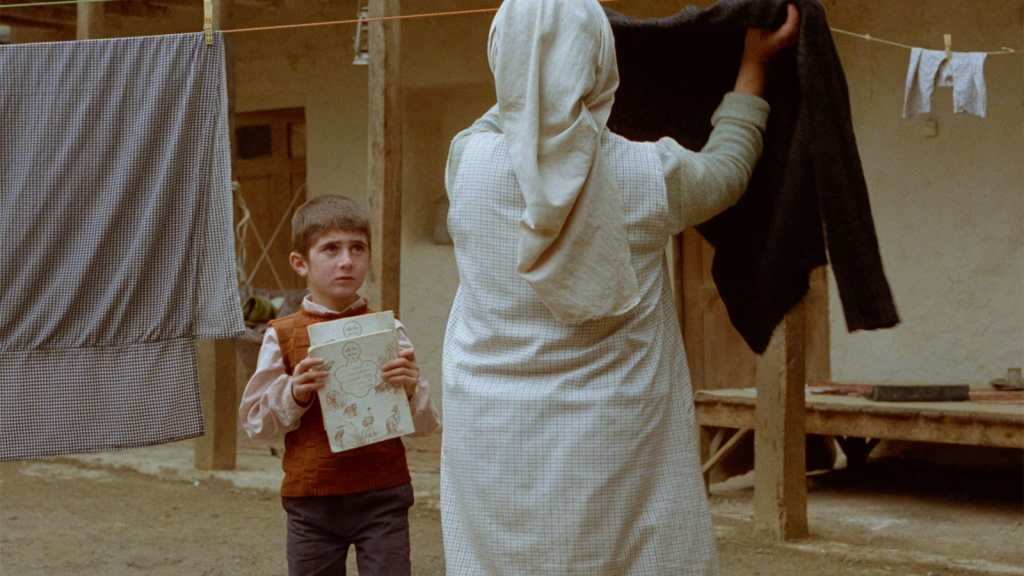
A Simple Event (Shahid Saless’s first work) is the daily repetition of a series of images that have taken on an instinctive form. Every morning a child wakes up, begins a circle, goes to school, arrives late, does not listen to the lesson, and in the afternoon quickly makes his way to the seashore. He takes a few smuggled fish his father has caught to a shop, takes the money to the tavern where his father spends every night drinking, and from there returns home to quickly eat the ash his sick mother has cooked. Listless, head bowed, withdrawn and sorrowful, he then opens his book, looks at it but does not read, and spreads out his bedding and goes to sleep. Late at night his father comes home as well. Drunk and senseless. One night, his mother’s illness suddenly grows worse, and finally, in the middle of the night, before the child can bring the town doctor, she dies. The next day, the pattern of this circle changes slightly. This time, when he leaves the liquor stand, there is no one at home to have cooked the soup, and his father sits him down at a table in the tavern and gives him something to eat there.
And night and sleep and school and smuggled fish and the tavern and home—the long, continuous repetition of a circular movement.
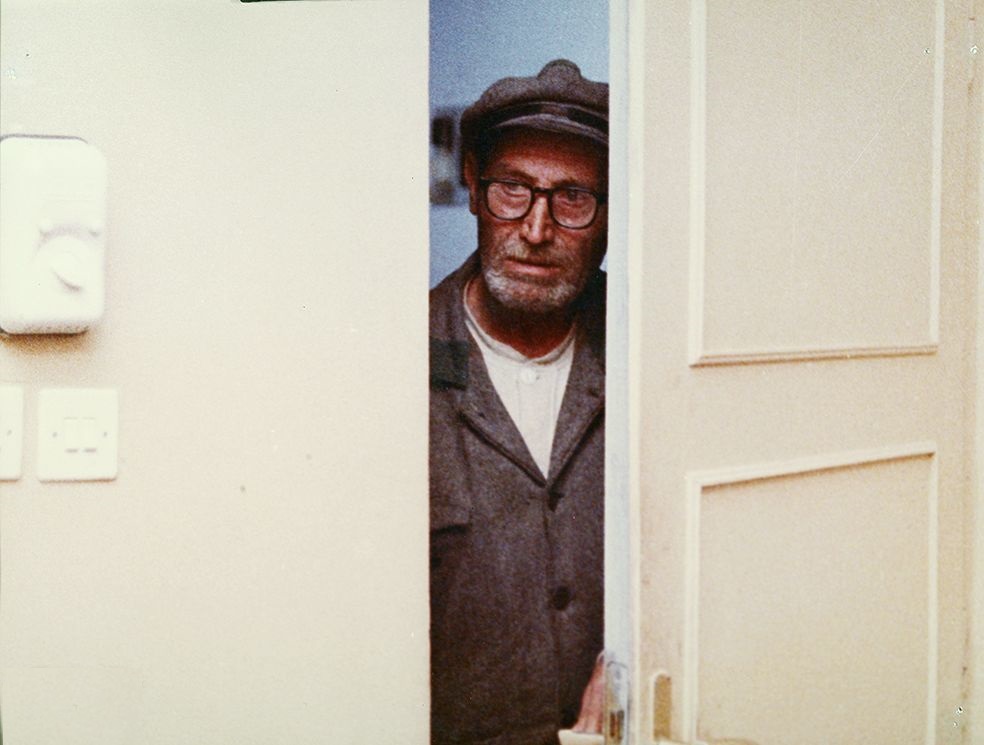
And Still Life, too, in a sense represents this same tiring persistence, with the small difference that the hero himself comes to face death, and he is in the midst of this circle. He is a railroad watchman who does not even know how old he is. He says that for about thirty years he has done nothing but turn the handles that operate the two crossing gates where the railroad meets the dirt road, again and again, at certain hours. The old man suddenly receives his retirement order, and that is the end of the line. Another watchman closes Sardari’s crossing gate forever. Mr. Sardari remains behind the barrier. What does it mean? Suddenly, after sixty or seventy years, he has the chance to look at himself in the mirror. He has grown old, he is broken, and he is dead—truly dead.
Mr. Mohammad Sardari’s wife. The mechanical doll of his home: she cooks, weaves carpets, lays out the bedding, sets the table and clears it, and pours the tea as well. The cold appearance of their relationship completes Sardari’s damp house, but how beautiful and mystical this relationship is.
Sardari complains to the buyers of his wife’s handwoven rugs, saying that she works herself to the bone from morning till night and it is all loss. This is the only sign of his passionate love for this dear shadow. And the movement Shahid Saless gives the man as he says this, while counting the money and turning toward the other corner of the room, where his wife sits like a design on the wall beside the carpet loom, brings before our eyes a vivid and telling scene.
In A Simple Event, the sea is life, from which the man takes his share every day, stealing it (by necessity). And in Still Life, the railroad is life: this long, cold, continuous iron line that Sardari protects with the crossing gate from every possible danger. It is life. Sardari receives his bread, his sugar and tea, and everything else from this cold, unending line. He lives beside this long line (as life in A Simple Event unfolds beside the sea), and in the end he receives his death sentence from this line as well. He is always worried about the water that will eventually carry this line away, unaware that the line itself is water, carrying away his life and all that belongs to him. A man spends a lifetime guarding something that will ultimately destroy his life. Sardari does not understand retirement, because he imagines that he must die right here, beside this very line.
“I’ve lost my job.” This is the refrain Mr. Sardari keeps repeating. He likes this repetition, this guarding and repeating; it means he has learned to live this way now. He has spent his whole life watching over the line, and now they are taking the line away from him. He finds himself in the mirror, and perhaps puts up such a hard, cold resistance to old age and death. He resists breaking this repetition, even by not buying his wife a new chador. And how quietly and sweetly the suggestion of buying this new chador is made: “What, are you going to a wedding?” And presumably it is only for a wedding that one should buy a new chador, because nothing new should disturb this calm, settled oldness.
He rises up against the new watchman who has arrived, but only for a single day, in a hard struggle. During that day, he and his shadow (his wife) constantly defy him. He locks the door so as not to let the watchman into his miserable, grave-like hut. This grave, where he has lived for thirty years and grown accustomed to everything in every way, must now be handed over entirely to someone else. How can he hand over his thirty-year-old grave to another? But by evening, this resistance—and the lock as well—breaks. Sardari and his wife invite the new watchman in and sit watching him eat hungrily. Everything about them—eating dinner, drinking tea, smoking cigarettes, and eating an orange for once—is natural and nice. The quiet arrival of their only child, his sleeping and eating, and his even quieter departure create a sorrowful atmosphere. His arrival leaves only a faint smile on the woman’s face, while his departure leaves a mute look and a vague expectation behind the glass.
In that damp little room, so close to the railroad and road crossing, their every small movement is a vivid and all-encompassing sign of the reality of life.
We all have, somewhere in our past, a damp little room beside these long, cold, parallel lines (which meet at infinity), where we have sat by a fogged-up window, watching the lines go by. We know nothing of Ahvaz, nothing of Gorgan, nothing of what lies far or near, our gray eyes staring blankly.
The tragedy of human life has never been portrayed so simply and without ornament, without any exaggeration. And when this smallest and most miserable damp opening onto the course of life is sealed by retirement, it creates a feeling of suffocation. A new generation has arrived, this time to sit and watch our passage along this line, toward an end that is near and perhaps infinite. Sardari’s meaningful gaze through the glass at the new watchmen, standing beside the line just as he did thirty years ago, bears witness to this. Sardari easily leaves behind thirty years of standing by the line; as his wife says, he takes the wrong road when he goes to complain. When he finds the right road, he feels that he must speak, complain, protest. But he has no strength for such a reaction. He comes to the conclusion that he must be beside himself to make his complaint, because, when he is himself, he has never learned why he should speak. So he turns to drink to find the words. (“Go on, my dear.”) And Sardari goes. They have taken the line away from him. He will die. He is dead. He was dead. He had been dead.
Without any ceremony, I am too insignificant to offer Sohrab Shahid Saless my thanks, gratitude, or praise for A Simple Event and now for Still Life.
Shahid Saless is the mystical cry of the lives of the ordinary people of this land, thousands upon thousands of whom retire every day, have retired, and had already retired. What else can his work be outside this realm? Only hope remains—and the hope that perhaps Shahid Saless, and no one else, will not make another film like Still Life for at least another ten years.
Iran Zamin Cinema is an independent, ad-free publication dedicated to Iranian cinema. Support the project on Buy Me a Coffee and help keep thoughtful essays and film analysis freely available.



Leave a Reply