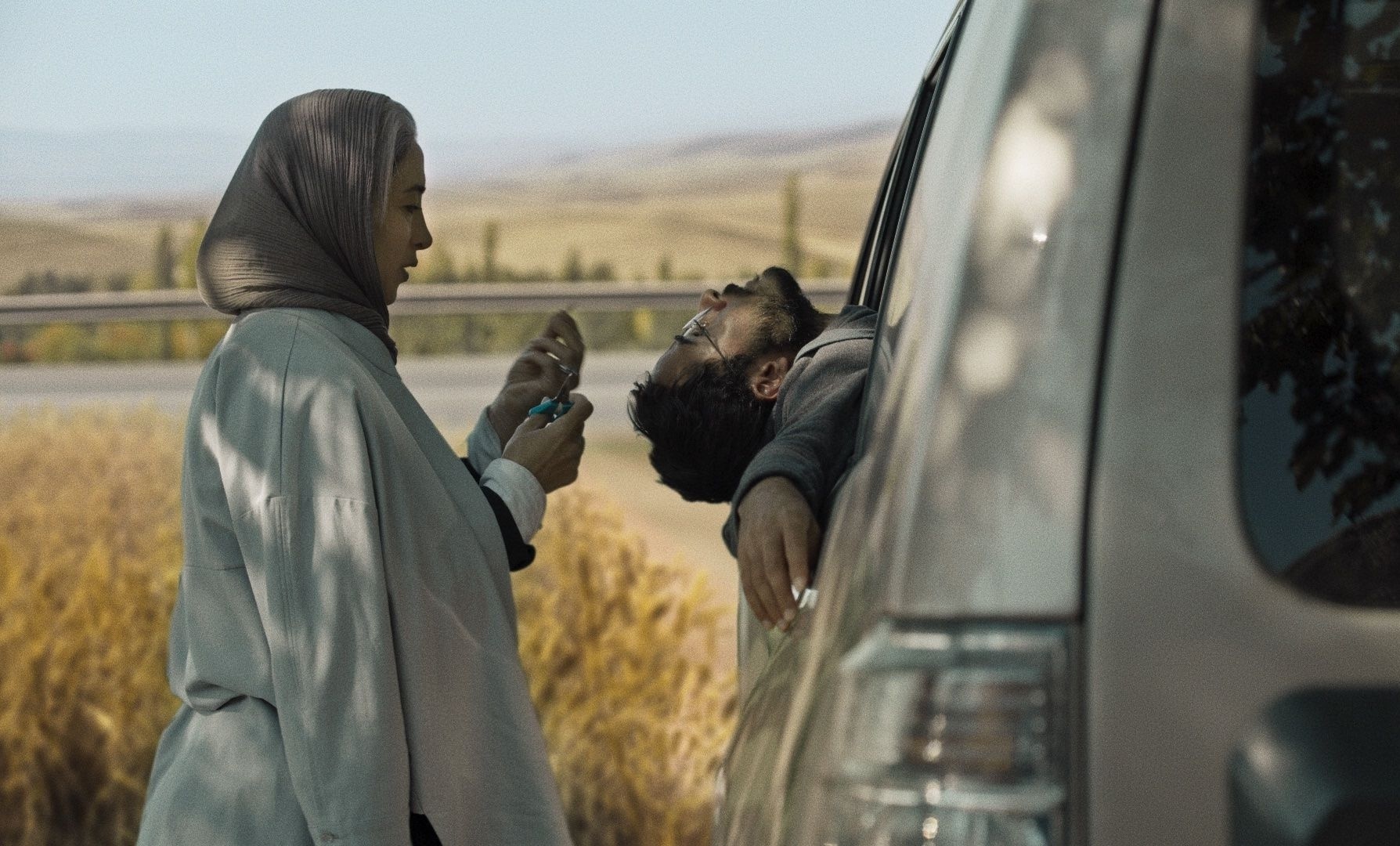
If you spend any time traveling across Iran, you will quickly notice a recurring sentiment among young people in the country’s major cities: many dream of leaving. Years of economic stagnation, political repression, and an uncertain future have turned emigration into a common life goal. Yet these same people remain deeply attached to their culture. Iranian pop songs fill taxi rides, and pride in Persian poetry endures despite widespread disillusionment. Leaving the country is therefore never just an escape. It also means losing a connection to the place that shaped one’s cultural identity.
Panah Panahi explores this paradox—the uneasy coexistence of joy and sorrow, freedom and loss—in his remarkable feature debut, Hit the Road (Jaddeh khaki, 2021). The director is the son of acclaimed dissident filmmaker Jafar Panahi, whose work has repeatedly exposed the realities of state censorship and the systematic erosion of women’s rights. While Panahi openly acknowledges his father’s influence, he avoids making an overtly political film. Politics remains in the background, emerging through implication rather than direct statement. The focus instead rests on a family drama and a melancholy journey across the Iranian landscape.
The story gradually unfolds as an extended farewell between the parents and their eldest son. Throughout the trip, songs by popular female singers from before the 1979 Revolution accompany the family’s drive. These songs are not simply part of the soundtrack. They exist naturally within the world of the characters. They embody the cultural memory of a homeland that must be left behind, yet can never truly be abandoned.
Looking for a legal way to watch Iranian films?
Explore the complete guide →
The influence of Abbas Kiarostami is equally unmistakable. Like many of Kiarostami’s films, Hit the Road confines much of its narrative to the interior of a moving car crossing Iran’s vast landscapes. The automobile becomes far more than a means of transportation. It is a space where affection, teasing, tension, and silence coexist. Meanwhile, the landscape outside the windows is never reduced to mere scenery. It becomes an emotional extension of the family’s inner lives.
We join a family of four already in the middle of their journey, with no clear sense of where they are going. The father (Hassan Majooni), confined mostly to the back seat because of an injured leg, alternates between dry humor and heartfelt tenderness. The mother (Pantea Panahiha) struggles to conceal her growing anxiety and sadness. Their older son (Amir Simiar) remains distant and reserved, while the youngest child (Rayan Sarlak) fills every moment with boundless energy, endless questions, and absurd ideas. Their relationships constantly shift between affection and sarcasm.

The sadness binding the family together is evident from the opening scenes, but its true source is revealed only gradually. Eventually, we learn that they are traveling to a remote mountainous region near Iran’s northern border, where the older son will cross into another country with the help of smugglers. Even then, the film refuses to explain every detail behind his decision. Emigration is treated less as a political issue than as an existential experience of separation.
The Sacred and the Profane in Hit the Road
Throughout the film, Panahi places the sacred beside the profane. Franz Schubert’s piano music appears alongside Iranian pop songs. Prayer gives way to conversations about walking the family dog—an animal traditionally regarded as ritually impure in Islamic law. At one point, the youngest son kisses the ground during prayer as an expression of reverence for creation, only for his mother to tell him not to lick the dirty ground. Later, the boy proudly recites a poem about urinating, and everyone else enjoys it. Even the jokes about Batman are more than playful parody. They become part of Panahi’s broader game of questioning myths, authority, and cultural icons.
This tension between the sublime and the ordinary should not be understood simply as political provocation. Religious experience is not necessarily presented in opposition to humor or physicality. Instead, the two constantly intermingle. In this sense, the film resonates less with Shi’a traditions of mourning than with Mikhail Bakhtin’s theory of the carnival. Bakhtin understood carnival as a social space where the sacred meets the bodily, hierarchies are temporarily overturned, and laughter acquires transformative power. The family’s journey resembles a pilgrimage in which spirituality naturally coexists with everyday life, arguments, and childish mischief. Here, laughter is not the opposite of grief. It is a shared response to it.
Panahi approaches death and renewal in much the same way. The older son’s departure becomes a symbolic death, marking the loss not only of a homeland but also of part of one’s identity. The film connects this personal experience to the gradual disappearance of the surrounding world. The family discusses the drying up of Lake Urmia, an environmental catastrophe that becomes a metaphor for a country in decline. Their dog slowly approaches the end of its life, while fog increasingly envelops the landscape. Yet Panahi never surrenders to despair. Death is not portrayed as an ending but as the necessary condition for renewal. The son’s departure is heartbreaking, but it also opens the possibility of another life.

The film’s visual style is equally striking. Slow circular camera movements gently connect members of the family through intimate close-ups. At another moment, the camera retreats into an extreme long shot. The characters nearly disappear into an expansive landscape, where solitary trees stand beneath sunlight breaking through heavy clouds. One deeply personal conversation between father and son is filmed entirely from a distance in a long static take, accompanied by the sound of a flowing river, the wind, and occasional birdsong. Panahi reminds us that cinema’s most meaningful moments often unfold not at the center of the frame, but along its edges.
Hit the Road serves as an excellent introduction to contemporary Iranian cinema for viewers discovering it for the first time. Those already familiar with the work of Abbas Kiarostami or Jafar Panahi will recognize echoes of their visual language. At the same time, they will encounter a filmmaker with a distinct artistic voice—one that confidently steps beyond its influences. Panah Panahi inherits the tradition of Iranian cinematic poetry, while enriching it with an unexpectedly playful, carnivalesque imagination in which laughter and melancholy emerge as two expressions of the same emotional truth.
Iran Zamin Cinema is an independent, ad-free publication dedicated to Iranian cinema. Support the project on Buy Me a Coffee and help keep thoughtful essays and film analysis freely available.


Leave a Reply