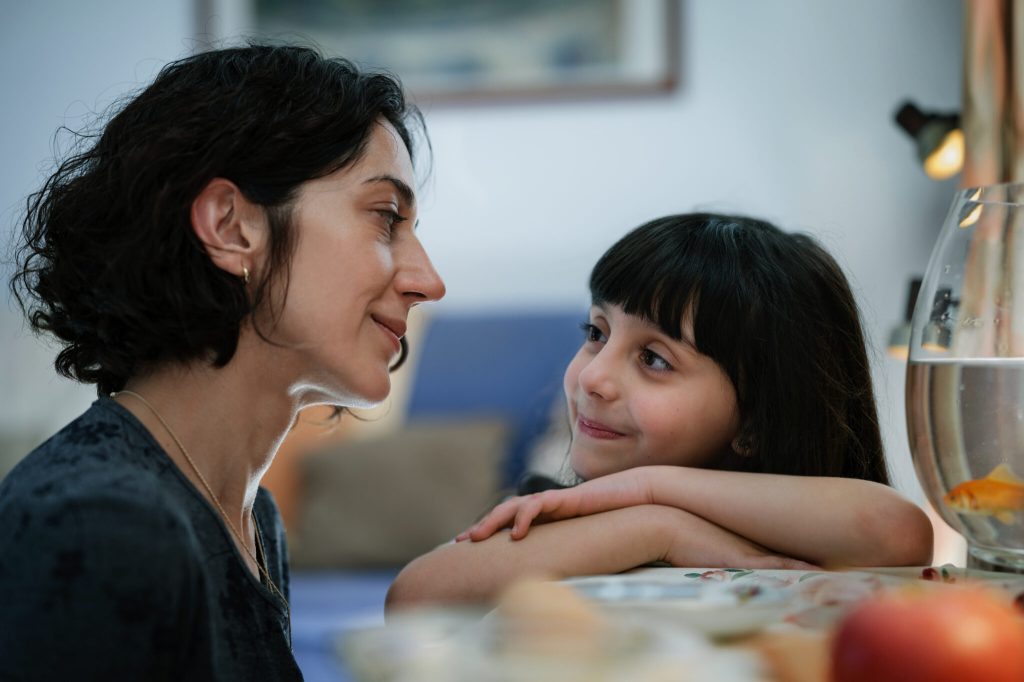
Originally from Iran, Niasari now lives and works in Australia. She began her artistic journey by making award-winning short documentaries in Lebanon. Shayda (2023), her first feature film, marks her entry into fiction filmmaking. Winning the Audience Award shows that the film, while dealing with domestic abuse, also has moments of lightness and reaches a wide audience.
Set in the 1990s and inspired by the director’s personal experience, the story follows Shayda (Zar Amir Ebrahimi), an Iranian woman living in Australia, who seeks refuge in a women’s shelter with her six-year-old daughter Mona (Selina Zahednia). There, under the care of the empathetic shelter director Joyce (Leah Purcell), she tries to rebuild her self-worth and be a strong support for her daughter. Even though her abusive husband Hossein (Osamah Sami) is planning to return to Iran, Shayda files for divorce and decides to stay in Australia. She faces prejudice and uncertainty, but as the Persian New Year approaches, she finds strength, courage, and a new sense of hope.
This emotional journey is often expressed through subtle, yet meaningful moments. In one scene, Shayda cuts her own hair in the bathroom. For her daughter Mona, this act carries powerful emotional meaning. The child intuitively senses that it’s not just about changing a hairstyle — it’s an act of freedom, a break from rules, and a personal statement by her mother.

The film doesn’t show domestic violence directly. Instead, it’s revealed through scenes in which Shayda records her testimony with Joyce. One particular incident is described twice — first, as Joyce reads Shayda’s account in English, and then again through an interpreter translating it into Persian. This double-layered, factual, and emotionally restrained recounting contrasts sharply with Shayda’s inner experience, which the camera focuses on at that moment.
The story thoughtfully integrates the Persian spring celebrations — from the fire-jumping ritual of Chaharshanbe Suri to the Persian New Year (Nowruz). Jumping over fire during Chaharshanbe Suri symbolizes purification, while Nowruz represents renewal and rebirth. These cultural scenes — full of Persian music and dance — enrich the social drama in a unique way.

At the same time, the film uses subtle irony to show the cultural dissonance. In Iran, Nowruz celebrates the arrival of spring and is filled with symbols of flowers and greenery. But in Australia, where the story takes place, it’s autumn. For Shayda, this creates a deep inner conflict — celebrating a spring holiday in the wrong season. This contrast highlights her feelings of alienation and the sense of living outside the natural rhythm — as a woman in exile.
While the film succeeds in portraying cultural tensions, it also falls into certain simplifications common in Iranian diaspora films. These films often portray Iranian characters and societal issues in schematic ways, without deeper nuance or efforts to present multiple perspectives. Sometimes, this is influenced by the genre itself. For example, A Girl Walks Home Alone at Night (Ana Lily Amirpour, 2014) blends horror, western, noir, and Jim Jarmusch-inspired aesthetics, yet remains a straightforward moral tale of female revenge.
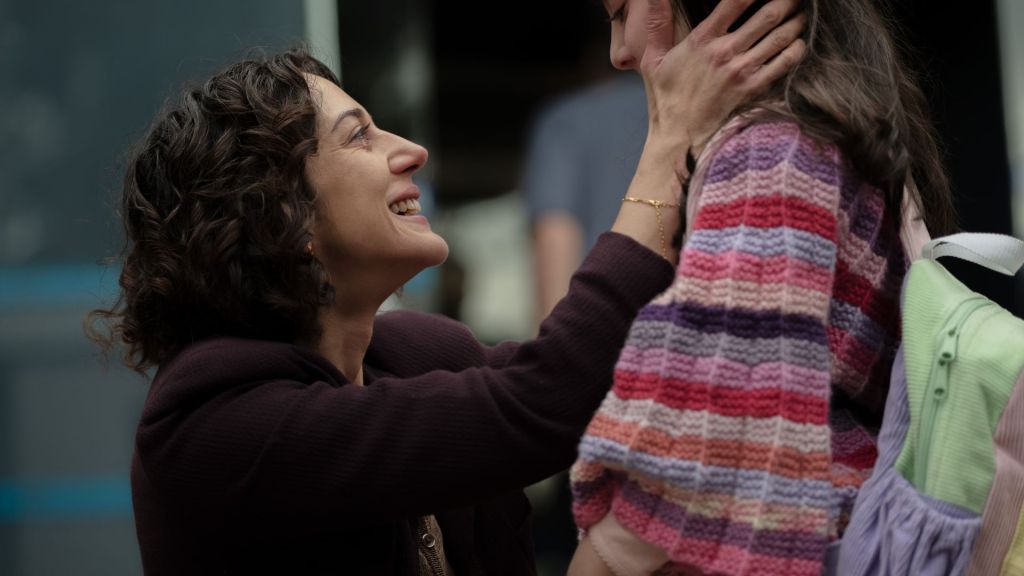
This trend is also visible in Shayda’s approach. This can make the film feel a bit too direct and predictable at times. The character of Hossein is portrayed mainly through his violent and misogynistic behavior, which lacks psychological or social complexity. The film also doesn’t provide a broader sociocultural context that would help the audience better understand the motivations behind each character’s actions. Shayda leans more toward Western ideologies and aesthetics rather than offering a distinct authorial voice.
On the other hand, it’s fair to acknowledge that Niasari makes an effort to introduce ideological balance, which is often missing in straightforward diaspora narratives. The abusive behavior is not limited to a Muslim husband. Niasari also reflects on violence within Western society — most women in the shelter are escaping Anglo-Saxon partners. In this way, the director explores domestic abuse in a broader context, showing it as a problem that crosses cultures and societies.
If you found this article valuable, please consider supporting this blog. Every share or even a small donation helps keep it going.

 Iran Zamin Cinema
Leave a comment